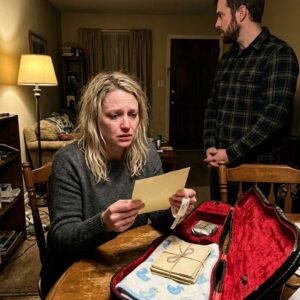
That silence was the clearest answer of all.
And that is when the mother finally said what had been true since the porch at the lake.
“You didn’t want me at the wedding,” she told them. “You wanted what my hands could do for it.”
The room, by most accounts, went completely still.
Because there are some sentences that do not need to be loud to destroy the last available excuse.
The son began to cry.
Not dramatically.
Not heroically.
Just the belated, embarrassed crying of a grown man suddenly forced to see himself from the outside. To see that his text had not been conflict avoidance. It had been cowardice. That he had not protected his bride from a difficult mother. He had participated in reducing his own mother to a service provider whose emotional place in the family could be revoked without consequence.
That recognition came late.
But it came.
The mother did not scream at him. She did not throw him out. She did not ruin the dress. In some ways, that made the moment harsher. She stayed fully professional. Collected the final payment. Completed the final fastening. Released the gown according to the terms that should have been honored all along.
Then she handed it not to Ava, but to Ava’s mother.
That gesture may have said more than any speech could.
Because by then the truth was simple: the work was finished. The family wound was separate. The dress could be released. Trust could not.
The wedding, according to the story now circulating, did go forward.
Late.
Tense.
Not quite in the seamless, glossy way Ava had imagined.
There were whispers about wardrobe delays. Questions about why the groom’s mother was missing. A brittle edge under the celebration that no amount of flowers or candlelight could fully soften. Because once a family truth gets exposed before the vows, the photographs cannot entirely hide it.
And the groom’s mother did not attend.
That was the boundary.
Not sabotage.
Not spectacle.
Absence.
The kind of absence that forces everyone else in the room to understand there was a seat that should have been filled by someone whose labor had shaped the day more than most of the guests would ever know.
What lingers most, though, is not the delayed ceremony or the frantic calls.
It is the sentence that revealed the entire arrangement in one breath: “She thought you’d still drop them off even if you were upset.”
There is a whole worldview inside that line.
The belief that mothers absorb pain quietly.
That skilled women keep rescuing other people long after respect has been withdrawn.
That hurt is a temporary inconvenience, but service is permanent.
That family, for some people, means having unrestricted access to another woman’s patience, labor, and forgiveness.