She didn’t sound like a celebrity controlling damage. She sounded like someone cornered by time, by memory, and by millions of watching eyes that refused to forget who she used to be.
“Having been a celebrity since my 20s, everyone knew what my face looked like,” she continued. “So plastic surgery wasn’t something I could hide. But I couldn’t hide from the mirror, either.”
And that is where the illusion truly collapsed.
Because the real pressure was never the camera.
It was the memory.
A face like hers doesn’t age in private. It ages against an archive. Against decades of frozen perfection that never change, even as the person behind them inevitably does. Every line becomes a comparison. Every shift becomes evidence. Every appearance becomes a referendum.
That is the unspoken contract of fame.
You are allowed to be seen.
But you are not allowed to change.
And if you do change, you must pretend you didn’t.
That contradiction is where so many careers quietly fracture.
Richards chose not to fracture.
She chose exposure.
The internet responded exactly the way it always does when illusion meets truth. Instantly. Violently. Completely divided.
One side called it courage. A refusal to play the game anymore. A moment of brutal honesty in an industry addicted to denial.
The other side called it surrender. Proof that even the most naturally iconic faces cannot survive the system without eventually submitting to it.
Both reactions missed something deeper.
This wasn’t just about beauty.
It was about control.
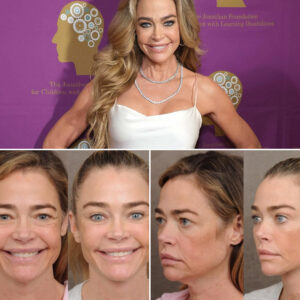
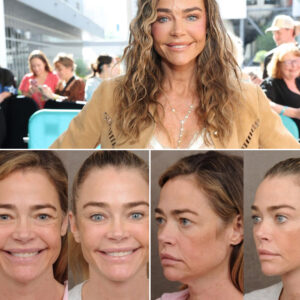
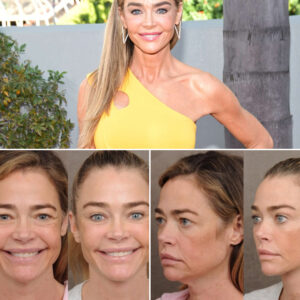
By allowing Dr. Talei to publish those images himself, Richards didn’t lose her narrative. She seized it. She bypassed the slow leak, the paparazzi speculation, the cruel side-by-side comparisons that would have come anyway. She eliminated the guessing game and replaced it with certainty.
Yes.
It happened.
And she is not hiding from it.
That decision changed everything.
Because now the conversation is no longer about whether she did it.
It is about why she felt she had to.
And that question doesn’t belong to her alone.
It belongs to everyone watching.
Because the truth sitting underneath those before-and-after photos is uncomfortable in a way that no procedure ever could be. The “after” is stunning. It is precise. It is technically brilliant.
But the “before” is what lingers.
Because the “before” was real.
It was time.
It was life.
It was human.
And when even a face like Denise Richards—a face once treated as untouchable—reaches a point where it feels like something must be corrected, restored, or reclaimed, the illusion doesn’t just crack.