For three years, my parents had treated my husband like a mistake I was too stubborn to correct.
Ethan Cole never tried to impress them. He didn’t wear flashy watches, didn’t talk about money, and didn’t bother correcting anyone when they assumed he was “still figuring things out.” My sister Claire’s husband, Daniel Mercer, was everything my parents admired. He was a CEO with a luxury car, a penthouse, and the kind of confidence that filled a room before he even spoke. At every holiday dinner, my mother praised Daniel’s promotions and my father asked Ethan, with a thin smile, whether he had “made any career progress yet.”
Ethan always handled it with quiet grace. Under the table, he’d squeeze my hand and change the subject before I could react. What my parents never knew was that Ethan had more success than Daniel could imagine. He had built a private emergency aviation company after leaving the military. His business managed medical helicopters, transport contracts, and assets large enough that he could have silenced their judgment with one sentence. But he never wanted our marriage to become a performance for my parents’ approval.
“When the time is right,” he always said. “Not because we have something to prove.”
I told myself I respected that. The truth was uglier. I still wanted my parents to choose me over appearances, and some part of me kept hoping they eventually would.
Then Ethan had to leave the country for a week to finalize a major deal. I told my parents he was away on a consulting trip because it was easier than listening to my mother ask whether he ever planned to get a “real title.” I was thirty-five weeks pregnant, uncomfortable and exhausted, but everything had been normal enough that I wasn’t worried.
That afternoon, I stopped by my parents’ house to deliver documents my father insisted could not wait.
I had barely stepped into the kitchen before a sharp pain seized my lower back. At first I thought it was the usual pregnancy pressure, but within minutes the contractions turned fierce and regular. I gripped the marble counter so hard my fingers ached.
“Mom,” I gasped, “please call 911.”
She didn’t even stand up. She stayed in her chair, scrolling through her phone as if I had asked her to pass the salt.
“Don’t be dramatic, Amelia,” she said. “First babies take forever. And if this is real, hurry up—I have dinner plans with your sister.”
Another contraction hit so hard my knees nearly buckled. I turned to the living room where my father sat with his newspaper open.
“Dad,” I said, crying now, “please call an ambulance.”
He lowered the paper an inch, barely enough to look at me.
“Your doctor is twenty minutes away,” he said. “Can’t you just wait?”
Warm fluid ran down my legs.
The panic that hit me then was total. My heart was racing, my vision was blurring, and I knew with terrifying certainty that this was not something I could “wait” through on my parents’ kitchen floor. I was shaking, crying, clutching my stomach, and the two people who were supposed to care about me most were acting like I was inconveniencing their evening.
Then I heard it.
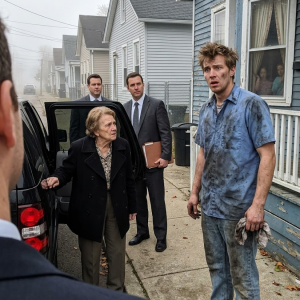
A deep, violent chopping sound above the house.