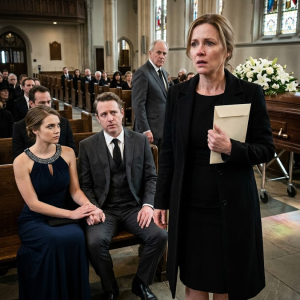
The church smelled of lilies, candle wax, and damp stone.
My daughter’s coffin rested before the altar beneath a spray of white roses so large it almost hid the polished wood.
People whispered into handkerchiefs.
Someone coughed and then apologized with their eyes.
Even grief seemed to know it should move quietly there.
I had not cried for the last ten minutes.
I had moved beyond crying into a strange, numb stillness, the kind that comes when the body can no longer understand what the heart has already been forced to accept.
Lucía was twenty-nine years old.
Two weeks earlier she had been choosing baby blankets.
Now her photograph stood beside a coffin while a priest turned thin pages with solemn fingers.
Then the church doors opened.
The sharp click of heels ran across the marble floor and sliced the silence into pieces.
Heads turned one by one, as if pulled by a string.
I turned last, because some part of me already knew I would hate what I saw.
Álvaro entered smiling.
He was wearing a dark suit that fit him too well for a grieving widower.
His hair was neat, his shoes shone, and there was not a trace of exhaustion in his face.
On his arm was a young woman in a fitted red dress, her lipstick immaculate, her expression bright with the casual confidence of someone who believed she belonged at his side.
A murmur passed through the pews.
The priest froze with his book open.
My sister Elena pressed her hand so hard into my arm that I could feel her nails through my sleeve.
Álvaro looked around as if he had arrived at the wrong part of a wedding.
Then he gave a small shrug and said, almost playfully, ‘Traffic downtown was terrible.’
The woman on his arm scanned the church, the flowers, the candles, the coffin, the framed photograph of my daughter smiling in a cream sweater.
Her eyes settled on me.
She released Álvaro’s arm, took two slow steps in my direction, and leaned close enough for me to smell expensive perfume.
‘Looks like I won,’ she whispered.
There are moments in life when rage becomes so total it no longer feels hot.
It becomes cold.
Precise.
I did not scream.
I did not strike her.
I did not collapse.
I simply stared at the coffin and felt something inside me harden into a shape it had never held before.
Because Lucía had been disappearing from herself for months, and I had watched it happen.
That last summer, she came to my house in long sleeves though the city was burning with heat.
She smiled too fast.
She flinched at loud sounds.
Once, when she reached for a glass, her cuff slipped back and I saw a fading bruise near her wrist.
She pulled the fabric down so quickly that we both pretended it had not happened.
Whenever I asked, she gave me the same answer.
Álvaro was stressed.
Work was difficult.
The baby was coming.
Marriage was hard.
He would change once he became a father.
She said it like prayer, like medicine, like a promise she had to swallow whole or die from the truth.
I told her to leave him.
Not once.
Many times.
I told her the spare