state of permanent exhaustion without falling apart.
Some nights he slept in a chair beside her incubator.
Some nights he drove home to a nursery Emily had painted in pale green and sat in the dark because turning on the light felt like admitting she would never walk into it.
The nurses celebrated every small victory.
A full bottle.
A steadier temperature.
An ounce gained.
Survival, Mark learned, often arrived in tiny measurements.
Emily’s burial was held on a cool morning under a sky so clear it almost felt disrespectful.
Mark could not bring himself to choose cremation after what had happened.
He buried her in a small cemetery on the north side of town beneath a maple tree that turned scarlet in autumn.
Lily was still too medically fragile to attend, so one of the NICU nurses stayed with her while Mark stood at the graveside with Emily’s parents and said goodbye to a casket for the second time in less than two months.
This time he did not feel paralyzed.
He felt hollow, exhausted, and very certain that love did not end just because a body did.
The trial began six months later.
By then Lily was home, small for her age but fierce, with Emily’s dark eyes and Mark’s stubborn chin.
Mark testified about the text message, the funeral arrangements, Simon’s pressure to move quickly, and the moment in the crematorium when he saw Emily’s abdomen move.
The courtroom went silent during that part.
The prosecution laid out the rest with merciless clarity: embezzlement, desperate debt, sedation, sabotage, then a calculated attempt to let fire erase the truth.
Simon’s defense argued panic, bad judgment, unintended consequences.
The jury returned guilty verdicts on murder, attempted murder of an unborn child, evidence tampering, and fraud after less than four hours of deliberation.
When the sentence was read, Mark did not look at Simon.
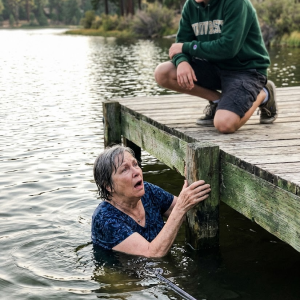
He looked instead at the wooden bench in front of him and thought about Emily laughing on a summer dock with one hand resting on the curve of her pregnant belly.
He had spent months fantasizing that conviction would somehow balance the scales.
It did not.
Nothing could return what had been taken.
But hearing the judge say out loud that Emily’s life had value beyond the way she died, and that Lily’s survival had forced the truth into daylight, gave Mark something quieter than satisfaction and steadier than rage.
It gave him an ending to the questions.
The first year after Lily came home was brutal and beautiful in equal measure.
Mark burned dinner often, learned to function on broken sleep, and discovered that babies did not care whether grief had hollowed their parents out.
They still woke at dawn.
They still needed bottles, baths, clean blankets, lullabies.
He kept a framed photo of Emily on the dresser in Lily’s room and spoke to it more often than he admitted to anyone.
At first he worried that talking about Emily would make the absence heavier.
Instead it became a way to keep love active, moving, present.
On Lily’s first birthday, Mark drove to the cemetery with a small cupcake in a box and a single white lily laid across the passenger seat.
The spring grass around Emily’s grave had grown thick and bright.
He carried