not being hired as a nanny.
My daughters are…
not well.’
A crash sounded overhead.
Then deliberate laughter.
Camila lifted her eyes to the staircase.
Six girls stood there in a line that felt less like curiosity and more like inspection.
Rowan, thirteen, carried herself with the rigid authority of a child who had promoted herself to command.
Mila, eleven, twisted the hem of her sleeve until her knuckles whitened.
Elise, nine, watched without blinking.
Noah, eight, folded inward as if trying to take up less space than her body required.
Piper and Wren, the six-year-old twins, wore matching expressions of polite menace.
Sofia, the youngest at three, held a threadbare stuffed fox so tightly its flattened tail stuck out between her fingers.
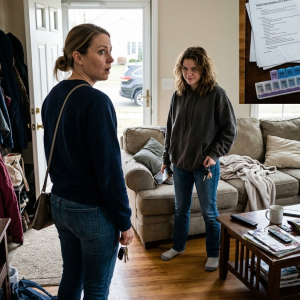
Camila looked up at them and said, ‘I’m Camila.
I clean houses.’
Rowan stepped down one stair.
‘You’re number thirty-nine.’
‘Then I’d better get started before lunch,’ Camila replied, and she walked into the kitchen as if she had not been challenged at all.
The kitchen told her more than Elliot had.
The refrigerator door was covered in photographs of Lucía: Lucía baking, Lucía laughing from a hospital bed, Lucía holding Sofia with one hand while the other girls crowded in around them.
In a drawer beside the stove, Camila found recipe cards and handwritten notes in looping blue ink.
Rowan likes coffee smell but not coffee.
Mila hates syrup touching eggs.
Elise calms faster if she slices fruit herself.
Noah takes honey in tea.
Piper and Wren want different cups even when they claim they do not care.
Sofia only sleeps with the fox.
None of the notes were dramatic.
That was what made them devastating.
They were the ordinary architecture of a mother who knew her children by heart.
That first evening Camila did not try to win anyone over.
She cleaned the counters, wiped the stove, sorted a stack of unopened mail, and then, using one of Lucía’s recipe cards, made banana pancakes shaped like animals.
She placed them under foil and walked away.
When she came back, Sofia was standing on a chair, chewing quietly with both hands around a pancake rabbit.
The child looked up in alarm, as if she expected the food to be taken back.
Camila only asked whether the fox needed a plate too.
Sofia gave a solemn nod.
It was the first almost-smile Camila saw in the house.
The next morning, the twins made their move.
A string had been tied to the pantry door handle, and when Camila opened it, a can of thick green tempera paint swung down from the shelf and burst across her shoulder and hair.
The kitchen froze.
Elliot, halfway through a call in the doorway, went white.
On the upper landing, Piper and Wren leaned over the banister waiting for the scream, the accusation, the exit.
Camila closed her eyes, wiped paint from her lashes, and looked up.
‘Tempera,’ she said calmly.
‘Good.
It washes out.’ The twins blinked, briefly unarmed.
Then Camila added, ‘Did the others run before or after the whispering?’ That was the moment the prank stopped being a game.
That night, while cleaning the upstairs hall, she found the source.
Behind a vent cover sat two old baby monitors, a phone loaded with voice memos, and a tangled