The plane touched down outside Chicago just after dusk, when winter turns every surface reflective and every memory sharp.
From the car window, the city looked almost exactly the way I remembered it from the Greyhound twelve years earlier, except that I was seeing it now through heated glass instead of scratched bus plexiglass, and I was arriving in cashmere instead of a thrift-store coat with a broken zipper.
The difference should have felt triumphant.
Instead, it felt surgical.
Donovan sat across from me in the SUV, reviewing the final documents on his tablet while snow gathered in powdery edges along the highway.
He never filled silence just to make it friendlier.
That was one of the reasons I trusted him.
He understood that some moments are not improved by language.
When we turned into Oakbrook, the houses began to change.
Wider lawns.
Deeper setbacks.
Tasteful uplighting.
Garlands on doors expensive enough to look effortless.
The country club sat up ahead like an illuminated stage set, all wreaths and old money and the particular self-congratulation of people who call tradition a virtue when what they mean is gatekeeping.
My parents’ house stood three streets beyond it.
I had spent years convincing myself it would look smaller when I returned.
It did.
The house was still large by any reasonable standard, but it no longer had the supernatural scale it had in my childhood.
The columns were narrower than memory.
The front steps were ordinary.
Even the brass knocker, once so intimidating that I used to polish it carefully before holiday parties, looked theatrical now, like a prop left over from a production that had run too long.
The only thing that felt exactly the same was the cold in my chest.
The porch lights were already on.
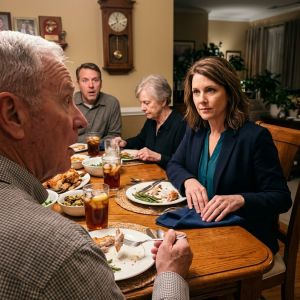
Through the front windows I could see the dining room chandelier burning above a table laid with crystal and silver.
Of course my mother had staged it perfectly.
She had always treated emotion like a room she could decorate into submission.
Donovan closed his tablet.
We’re within the window for service, he said.
Once you give the signal, everything goes live.
I kept looking at the house.
What if she isn’t there? I asked.
He knew I meant my grandmother.
Then we go to Roseview tonight, he said.
I already have staff on notice.
That was why he was Donovan.
He never came to a battlefield with one plan.
I touched the locket inside my bag and got out of the car.
The cold hit my face first, then the smell of pine and snow and chimney smoke, and under it all the faint ghost of the house itself.
Lemon polish.
Old upholstery.
Money trying to smell dignified.
I rang the bell.
For one strange second I thought my mother might actually make me wait, might choose that as the first petty assertion of control.
But footsteps came quickly, and then the door opened.
It wasn’t a butler.
They couldn’t afford one anymore.
It was my mother.
She had aged well in the cruel, curated way some wealthy women do.
Her hair was still carefully colored, her posture still exact, her sweater still probably cashmere, but the maintenance showed now.
The skin beneath her makeup was thinner.
The elegance had become effort.
She