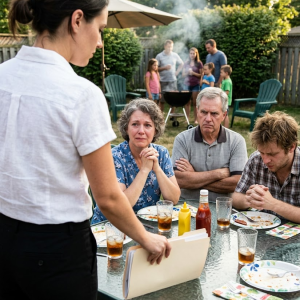
froze when she saw me.
Not because she was happy.
Because for one honest second, before the performance started, she looked frightened.
Mallalerie, she said.
No hug.
No reach.
No tears.
Just my name, spoken like she was checking whether something imaginary had learned to answer.
You asked me not to be late, I said.
That seemed to wake her.
She stepped aside immediately, instincts reassembling.
Come in.
Your father is waiting.
Of course he was.
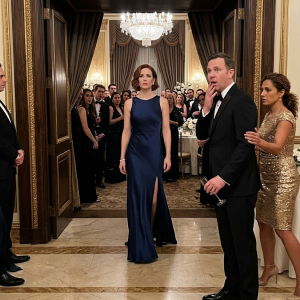
The foyer was almost unchanged.
Same black-and-white marble.
Same sweeping staircase.
Same oversized mirror framed in gilt.
I caught my reflection in it as I passed: black dress, straight shoulders, diamonds at my ears, face composed into something my younger self would have mistaken for fearlessness.
Maybe it was.
Maybe it was simply exhaustion sharpened into purpose.
My father stood at the end of the hall near the dining room entrance, one hand resting on the back of a chair as if he had placed himself there for maximum authority.
Reginald Reed was the kind of man who had built his entire personality out of controlled volume.
He never needed to shout because he had spent decades training everyone around him to interpret calm as danger.
He looked older than my mother, and far more surprised by it.
The recession at his temples had gone silver.
His skin had loosened at the jaw.
The expensive suit was still expensive, but it hung a little wrong, the way clothing does when its owner has been losing sleep and pretending not to.
He gave me a long, measuring look.
Then he smiled.
Mallalerie.
You look successful.
That was his version of welcome.
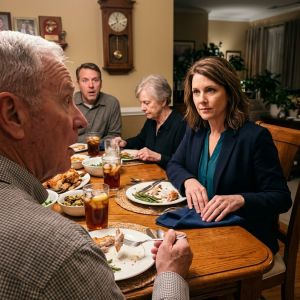
I walked into the dining room and took the seat opposite his.
My mother moved automatically to the sideboard to pour wine.
No, thank you, I said.
She set the bottle down without comment.
A roast sat between us, untouched.
Side dishes steamed gently in serving bowls.
Candles burned with that deliberate holiday warmth people buy when they want a scene to feel emotionally credible from a distance.
Donovan entered behind me and took a place along the wall, not seated, not announced, simply present.
My father’s eyes flicked toward him and narrowed.
I assumed this would be private, he said.
You assumed many things, I replied.
There it was.
The first clean hit.
My mother folded her napkin too neatly in her lap.
Let’s not begin with hostility.
I looked at her.
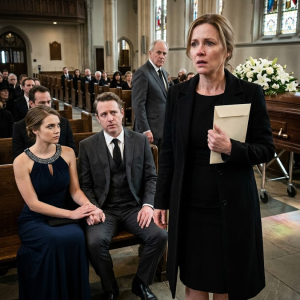
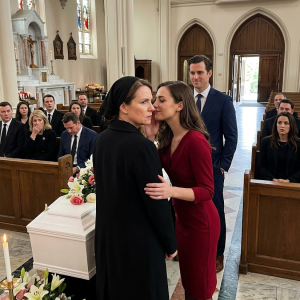
You held a funeral for me.
The room went still enough that I could hear the heating vents.
My father leaned back.
The memorial was symbolic.
Symbolic, I repeated.
You left under ugly circumstances, he said.
There was gossip.
Speculation.
Questions.
We chose a version of events that protected the family from unnecessary scrutiny.
I almost laughed.
You announced that your living daughter had died because it was socially cleaner than admitting she disobeyed you.
My mother’s mouth tightened.
You were unstable then.
No, I said.
I was inconvenient.
My father cut in before she could answer.
We didn’t ask you here to relitigate adolescence.
There it was too.
Not daughter.
Not child.
Not pain.
A scheduling inconvenience from the distant past.
Then why did you ask me here?
He steepled his fingers.
Reed Strategic Holdings has hit a temporary liquidity