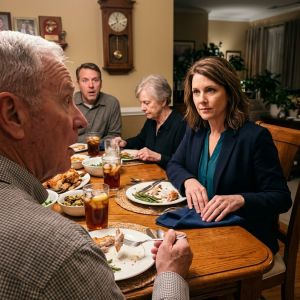
The glass hit Courtney before she saw Emily’s arm move.
One second she was reaching for her water, trying to keep the dinner from turning into another family spectacle, and the next there was a sharp crack against her cheekbone and a scatter of glittering shards across the tablecloth.
The room froze.
Nobody shouted.
Nobody leaped up.
Nobody even asked whether she was hurt.
Courtney pressed her hand to her face and felt the thin, hot line of blood.
Across from her, Emily was breathing hard, her polished hair slipping over one shoulder, her mouth twisted with the kind of anger that always seemed to come out of nowhere and then, somehow, become everyone else’s problem.
“You need to learn your place,” Emily said.
Their mother inhaled softly, as if the real offense were the tension in the air, not the object that had just been hurled across the table.
Then she said the sentence Courtney had heard in one form or another all her life.
Emily was under stress.
Emily was emotional.
Emily didn’t mean things the way they sounded.
Courtney looked around the room.
Her father wouldn’t meet her eyes.
A cousin stared down at his plate.
An aunt pursed her lips, embarrassed on behalf of the evening, not on behalf of Courtney.
It was one of those moments that split a life cleanly in two.
There was the version of her that had spent three decades absorbing, smoothing over, forgiving, and waiting to be treated like a daughter instead of a shock absorber.
And then there was the version sitting there now, napkin pressed to her face, realizing she had been training everyone around her to expect her silence.
She said nothing.
She drove home.
She cleaned the cut.
She stood under the bathroom light and watched herself stop making excuses.
The scar would be small, David later told her.
In a few months most people wouldn’t even notice it.
Courtney knew that was not the point.
The point was that the glass had not come out of nowhere.
It was only the most visible expression of a pattern that had defined her family for years.
Emily erupted; everyone else adjusted.
Emily lied; everyone else translated.
Emily took; everyone else quietly shifted to make room for what was missing.
Courtney had always been cast in the opposite role.
She was the capable one, the one with the practical job and the reliable car and the emergency savings account.
She was the daughter relatives called when they needed tax advice, contract help, budget rescue, or a place to stay for a weekend.
Her competence had become a kind of curse.
Because she was strong, people imagined she could not be hurt.
Because she was calm, people assumed she was fine.
Because she rarely made scenes, they mistook that restraint for proof that no one needed to defend her.
Emily, three years younger, floated through life on a different current altogether.
She was magnetic when she wanted to be, soft-voiced with strangers, funny in small groups, glowing in photographs.
Their mother loved saying Emily had a spark.
Their father called her fearless.
By the time Courtney was old enough to recognize manipulation, the language around Emily had already been set in stone.
Her tantrums were passion.
Her demands were