night, accompanied by photographs of Courtney’s injured cheek.
Marcus went white first.
Then Courtney’s father sat down without being asked.
Her mother kept saying there had to be an explanation, but the tone changed with each repetition.
At some point it stopped sounding like certainty and started sounding like fear.
Emily tried every tactic she had.
She cried.
She accused Courtney of setting her up.
She said Courtney was jealous because Emily had love and attention and a wedding.
She claimed Marcus knew about the debt.
Marcus stared at her and quietly said he knew nothing about any of it.
She insisted the purchases were gifts.
David slid forward copies of store communications and profile records.
She said the box was not hers.
David produced the rental information and the investigator’s notes.
She turned on Courtney and said this was cruelty, that sisters did not do this to each other.
Courtney heard herself answer in a calm voice she had never used with Emily before.
Sisters also do not steal each other’s names, destroy each other’s credit, and throw glass at each other’s faces.
That was the moment the room shifted.
Not because Emily suddenly confessed.
She did not.
Not because their mother apologized.
She did not, not yet.
The shift happened because everyone present finally ran out of places to hide.
There was too much paper.
Too much detail.
Too much consistency.
Truth, once documented, has a weight that charisma cannot lift.
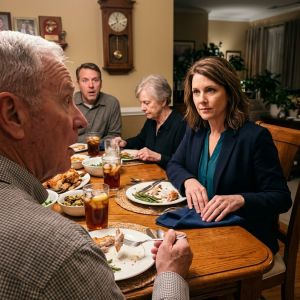
Marcus removed his engagement ring from his finger and set it on Courtney’s kitchen table.
He did it gently, almost sadly.
Then he looked at Emily and said the wedding was over.
He thanked Courtney for telling him before they got married, picked up his coat, and left the house without another word.
Emily screamed after him, then spun toward Courtney with a look so raw and hateful that for one instant Courtney saw the child and the adult versions of her sister collapse into the same person.
Emily reached as if to sweep the documents off the table, but David stepped between them and reminded her that a protective order was being sought and that any further aggression would worsen her position immediately.
Courtney’s father spoke next.
His voice was low and shaken.
He asked Emily one simple question: Had she done it?
Emily looked at him, looked at their mother, looked at the scattered evidence, and chose the oldest strategy in her body.
She burst into tears and ran.
Their mother moved as if to follow, then stopped in the doorway.
She turned back toward Courtney, opened her mouth, and closed it again.
For the first time in Courtney’s memory, she had no usable sentence.
The legal process after that was not dramatic.
It was slow, formal, and devastating in a very adult way.
Investigators confirmed what David had already pieced together.
Account records connected the applications to devices and locations linked to Emily.
The post office box tied back to her identification.
Additional merchant records strengthened the case.
Faced with the evidence, Emily’s attorney pushed for a plea rather than a trial.
Courtney did not enjoy any of it.
That surprised people.
Some relatives later hinted that she must have felt vindicated, triumphant, maybe even thrilled.
She felt grief, mostly.
Grief for the sister