Rain has a way of preserving memory.
Even now, years later, if I hear tires hissing over wet pavement after dark, I am back on that Ohio porch with a duffel bag at my feet and my mother’s words still hanging in the air like smoke.
She had said I was exhausting them.
My father had said almost nothing, which in some ways hurt more.
Silence can feel like agreement when you are thirteen.
I remember the porch light buzzing, the hem of my jeans soaking through from the rain, and the humiliating way I kept glancing toward the front window expecting someone to change their mind.
No one did.
That was the first adult lesson I ever learned completely: some doors do not close slowly.
They slam.
Thomas Reynolds arrived twenty minutes later in a black sedan that looked absurdly expensive against our sagging curb.
I knew him only as the uncle who attended holidays rarely, brought polite gifts, and left early before the shouting started.
He stepped out in a dark coat, looked from me to the house, and seemed to understand everything without being told.
He did not comfort me.
He did not perform outrage.
He simply opened the trunk, put my bag inside, and told me I was coming with him.
Through the rain-specked window, I saw my mother lower the curtain with two fingers.
My father never appeared at all.
His house was in the northern suburbs of Chicago, all limestone, clean lines, and rooms that smelled faintly of cedar and paper.
It felt less like a home the first week than an institution run by one exacting man.
Breakfast was at seven.
Schoolwork was done before dinner.
Excuses were examined, then discarded.
He was not cold, exactly.
He was careful.
He asked what I needed only after he had already arranged it.
A therapist began seeing me on Thursdays.
A tutor came on Mondays and Wednesdays.
A tailor altered two school uniforms after I lost weight from stress.
Thomas never once told me I was lucky.
He behaved as if stability were the minimum any child should expect.
For a while I mistook his reserve for indifference.
I was a frightened teenager; I still measured love by volume, by tears, by whether someone wrapped their arms around you when you cried.
Thomas was made of quieter material.
He noticed things and answered them before they became disasters.
When I stopped eating lunch at school because I hated sitting alone, he arranged for me to join debate club and never mentioned it had been his idea.
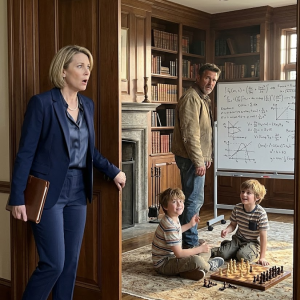
When I failed an algebra exam and tried to hide the grade, he slid the paper back across the table and told me shame was useless unless it became effort.
When I had a nightmare bad enough to wake the whole house, he appeared in the doorway, waited until my breathing settled, and then sat outside the room reading until dawn.
He loved the way some people build sea walls: not with spectacle, but with structure strong enough to hold when the weather turns.
About a year after I moved in, I asked him the question I had been carrying like a splinter.
Why me.
Why had he come that night.
Why had he taken responsibility for a child