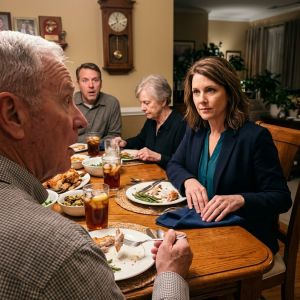
My mother’s birthdays used to be uncomplicated.
A sheet cake.
A crowded dining table.
My brother Mike repeating the same speech about how Mom kept the family together through every hard season we’d ever had.
Back then, the rituals felt tired but harmless.
We showed up, we ate too much, somebody opened a second bottle of wine, and everyone went home with leftovers wrapped in foil.
Then Tyler got older, and the center of gravity shifted.
Tyler is Mike’s son, and from the time he learned how to charm one adult against another, he understood exactly where the power sat in our family.
My mother adored him with a kind of devotion she had never shown anyone else.
Every rude remark became honesty.
Every selfish decision became leadership.
Every act of cruelty was dismissed as intelligence arriving faster than manners.
By fourteen, he had absorbed the lesson completely: if he made people laugh, he would never have to answer for what he said.
My name is Stephanie.
I’m thirty-nine, I own a specialty gift shop downtown, and I rebuilt my life around small beautiful things after my daughter Lily died at six.
She was warm and funny and obsessed with anything that sparkled.
After she was gone, silence in my house felt like a second funeral.
The shop gave me somewhere to put my hands.
Somewhere to put my grief that wasn’t just collapsing under it.
Most people in town know that about me because they watched me build the store from scratch.
My family knows it too, but they treat grief like a weakness if it belongs to someone else.
Mike’s family refers to Lily as my sad chapter when they think I’m out of earshot.
Tyler once called me “the aunt who used to be a mom,” and when I told Mike what he’d said, Mike only shrugged and said, “He’s testing boundaries.”
When I told my mother, she sighed like I was exhausting her and said, “Stephanie, he’s just a kid.”
That phrase followed me for years.
He’s just a kid.
As if children arrive in the world speaking cruelty in full sentences with no adult ever placing the words in their mouths.
Two days before my mother’s birthday, she called me with a voice so sweet I knew immediately there was an angle.
“Stephanie, I really want you there,” she said.
“Tyler was asking if you’d be coming.”
Tyler never asked about me unless he was planning to use me, mock me, or both.
Still, I went.
I wish I could say I went because I believed the evening would be different, but that would make me sound more hopeful than I actually was.
The truth is simpler and sadder: I kept showing up because I had spent years confusing endurance with love.
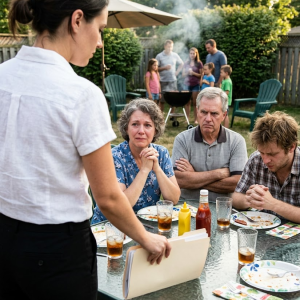
The party was at Mike’s house.
By the time I pulled into the driveway, music was already pushing out through the open windows.
Balloons crowded the entryway.
Someone had taped curling ribbon to the banister.
The whole place smelled like grocery-store frosting and grilled meat.
I walked in carrying a gift bag with a silver necklace for my mother.
It was simple and tasteful, exactly the kind of thing she used to like before she started measuring affection by spectacle.
No one noticed