looked awkward, overcorrected, the way teenagers do when they are trying to inhabit a better version of themselves without yet knowing how.
He stood by the register twisting the strap of his backpack until I walked over.
“I came to say sorry,” he said.
I didn’t help him.
He reached into his bag and handed me a folded sheet of notebook paper.
The handwriting was uneven and too careful.
The note said he had repeated things adults said because it made him feel powerful.
It said he thought grief was a joke because everyone around him treated mine like a personality flaw.
It said that after the truck was taken, his dad blamed him for opening his mouth, and that was the first time Tyler realized jokes only stay funny for people who don’t pay for them.
The last line stopped me cold.
It said, You didn’t stop being a mom because Lily died.
I was cruel because it was easier than thinking about that.
I folded the paper once and set it on the counter.
“An apology matters when behavior changes,” I told him.
He nodded.
“I know.”
He started coming in every few weeks after that, usually to buy something small for school gift drives or for Jenna.
He was quieter.
He said please.
He asked questions and actually waited for answers.
I did not become his second mother, and I didn’t try to.
But I stopped seeing only the boy who had learned cruelty.
I started seeing the boy who had finally witnessed it clearly enough to reject it.
My relationship with Mike never recovered.
We became polite strangers at a distance, which was more peaceful than being family up close.
My mother tried twice to force a reconciliation.
The first time, she mailed back the birthday necklace I had given her, still in the box, with no note inside.
The second time, she showed up at my store and said, “I hope you’re happy now.”
I surprised both of us by answering honestly.
“I’m calmer,” I said.
“That’s better.”
She stood there waiting for me to chase a softer ending.
I didn’t.
After she left, I opened the necklace box.
For a long time I looked at that silver chain and felt only the old ache of trying to hand love to someone committed to refusing it.
Then I put it on.
It suited me more than it ever would have suited her.
A year after that birthday, I closed my shop early on a warm evening and sat by the front window with a cup of tea while the sun went gold over Main Street.
Tyler came by to buy a candle for Jenna’s birthday with money he had earned mowing lawns.
He called me Aunt Steph.
He did not perform kindness.
He just practiced it.
When he left, I locked the door and caught my reflection in the glass.
The necklace gleamed at my throat.
The store lights warmed the shelves behind me.
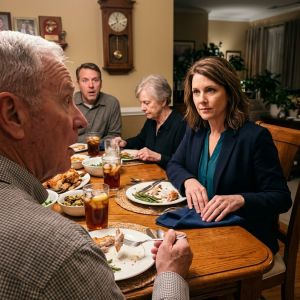
For the first time in a very long time, I did not feel like the woman at the wrong table.
I felt like the woman who had finally stopped begging for a seat and built her own place instead.
And that, it turned out, was a far better ending than the