think that peace was often just that: a series of unremarkable moments no one had to survive.
Brooke set the knife down and leaned against the counter.
“I used to think the worst part was him hurting me,” she said.
“But it wasn’t.
The worst part was feeling myself get used to it.”
Dorothy looked at her.
“That’s why records matter,” she said.
“That’s why witnesses matter.
Fear wants to make the abnormal feel ordinary.
The truth puts its proper shape back.”
Brooke considered that, then nodded.
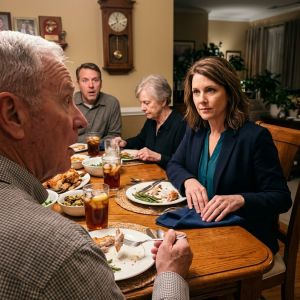
When dinner was ready, they carried bowls to the table.
Adam was driving in for the weekend.
Diane was scheduled for a therapy-supported visit two days later.
Life remained complicated, unfinished in some ways, scarred in others.
But it was no longer ruled by silence.
Months after that, when the last family court review closed and Brooke’s placement became a stable long-term arrangement by her own choice, Dorothy went through the note on her phone one final time.
Forty-one entries.
Dates.
Bruises.
Silences.
Suspicion made visible.
She did not delete it.
Instead she exported a copy to a secure folder and kept the original where it had always been.
Not because she expected to need it again.
Because it marked the exact place where she had refused to look away.
Later that night, she found Brooke asleep on the couch under a blanket, one arm flung over her face, a schoolbook open beside her.
The posture was graceless and deeply young.
Dorothy stood in the doorway for a moment and listened.
No raised voices.
No footsteps to brace against.
No hidden phone under a pillow.
Just the ordinary sound of a safe house holding someone who knew, at last, that she could rest inside it.
Dorothy turned off the lamp, left the hall light on low, and went upstairs.
For the first time in a very long while, the night felt quiet in the right way.
And when the phone did not ring, no one in that house mistook the silence for danger.