I looked at her and understood something terrible.
She had never thought of herself as a criminal.
She thought of herself as a chooser.
A judge.
A mother so convinced of her own authority that she believed biology, consent, law, and grief all bent beneath what she considered best.
I whispered, “You let me think they were dead.”
Her face hardened. “It was cleaner.”
Cleaner.
There are words that should be illegal in certain mouths.
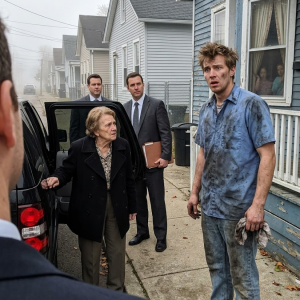
Detective Ruiz arrested her there in my kitchen.
She did not resist.
She simply kept looking at Ethan, waiting for him to do what he had probably done his whole life—translate her harm into complexity, ask for calm, save her from the full shape of what she had done.
He didn’t.
He stepped back from her like she was physically dangerous.
For the first time since I had known him, his voice came out with no softness in it at all.
“If they are alive,” he said, “and you let us bury them in our minds for seven years, then I don’t have a mother anymore.”
That landed.
I saw it land.
Helen’s face changed then.
Not enough.
But some.
She was taken out through the front door while the pears sat bright and stupid on my counter.
The next three days were consumed by law.
Meetings.
Emergency motions.
Family court.
State investigators.
A child welfare team that had to balance the most impossible question in the whole story: what do you do when two children are not missing, not abused in the ordinary sense, not unsafe where they are—but living inside a lie built from the theft of their own identities?
Rebecca and Samuel Colter were located the same day.
They did not run.
That mattered too.
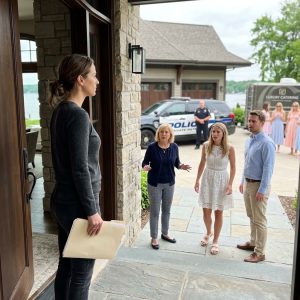
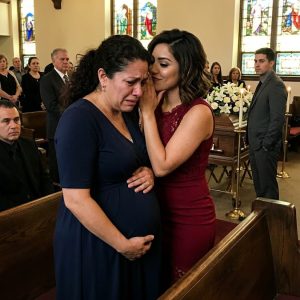
By the time we met them in a supervised legal setting, they already knew the secret had detonated. Rebecca cried before I even sat down. Samuel looked like a man who had spent seven years waiting for a door to open and finally hearing the hinges.
The truth, when it came, was monstrous and smaller than I expected all at once.
Rebecca had indeed been desperate for children. Multiple miscarriages. Failed adoption efforts. A church social orbit where everyone knew Helen and trusted her severity as wisdom. Helen told them there had been “complications,” that Ethan and I were unfit, that the babies would be taken by the state, that a discreet private guardianship could save them from foster care and scandal. Samuel resisted at first. Rebecca did not. Then both of them signed.
Not innocent.
Not identical in guilt.
But not the masterminds.
Just the sort of weak and hungry people monstrous women recruit.
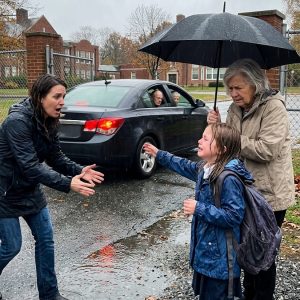
The girls—my girls—had been raised as Lily and June Colter, which at least meant one mercy had survived. Helen had kept the names. Whether that was sentiment, vanity, or some twisted idea of compromise, I do not know. I only know that when I heard they still answered to the names I whispered into my pillow for seven years, I nearly fell out of my chair.
The first meeting happened ten days later.
I had imagined that moment a thousand different ways once I knew they were alive.
I had imagined screams.
Running arms.
Recognition like lightning.
It was nothing like that.