been held in Rebecca’s trust and because Andrew’s misconduct was so thoroughly documented, he left with nothing that mattered. No house. No custody argument. No settlement victory. No elegant public narrative. Just a prison number, a stack of judgments, and the wreckage of his own calculations.
Claire left Columbus before summer.
No one missed her.
Rebecca, however, stayed.
She returned gradually to life, first through routine, then purpose. She spent mornings with Grace and afternoons in therapy. She relearned strength in small ways: carrying groceries without wincing, sleeping through the night, laughing without guilt, opening mail without dread. A year after the trial, she launched The Grace House with seed funding from her own trust and quiet operational help from Bill.
It was not a monument to revenge.
It was a safe transitional residence and legal support network for women leaving violent relationships. Rebecca insisted on practical things first: emergency childcare, legal referrals, temporary transport, digital security classes, confidential financial counseling. She had learned exactly how abuse hides inside polished lives, and she was determined to make escape less lonely for someone else.
Bill attended the opening but stayed in the back.
That was new for him too.
The true ending came on an ordinary Sunday, which is how the best endings often arrive.
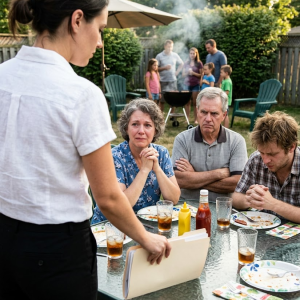
Grace had just turned one. The birthday gathering was small, held in Bill’s garden behind the old brick house he kept outside the city, the one Rebecca had always loved more than his penthouse because it smelled like cut grass and memory instead of money. There were white flowers on the table, a cake Grace mostly smashed, and enough sunlight to make everyone look healed for a few hours.
Rebecca stood barefoot in the grass, Grace balanced on her hip, laughing as frosting found its way into the baby’s hair. There was strength in her posture again. Not the brittle strength of surviving something. The quieter kind that comes after surviving and then choosing a life anyway.
Bill watched them from the patio steps.
Rebecca looked over and caught him staring.
‘What?’ she asked.
He shook his head once. ‘Nothing. Just trying to remember whether she always had your stubborn chin.’
Rebecca smiled. ‘She does.’
A moment later she added, softer, ‘You know he didn’t destroy me.’
Bill met her eyes.
‘I know,’ he said.
And he did.
Andrew had destroyed his own perfect life the night he chose cruelty over love and entitlement over decency. Everything that followed—the arrest, the trial, the public ruin—had only exposed what was already rotten. What remained standing was not his polished image, not his career, not the expensive shell he had mistaken for power.
What remained standing was Rebecca.
And Grace.
And the family he had nearly broken without understanding that some families do not collapse when tested.
They become impossible to move.
When Grace took three unsteady steps across the grass toward her mother and fell into Rebecca’s waiting arms, everyone laughed. Bill laughed too, then looked up into the late afternoon light and felt, for the first time since that 2:17 phone call, that the night was truly over.
It was.
Andrew Carter’s perfect life had ended overnight.
Rebecca’s had begun again.