his own heart.
You will know, he said.
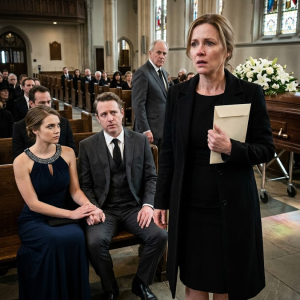
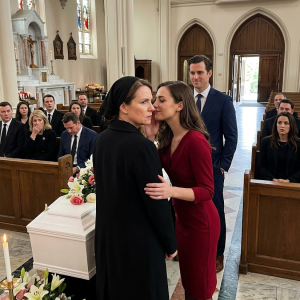
At the graveside, staring at Thomas’s empty chair while wet roses darkened on the casket lid, I knew.
The reception after the burial was held in the penthouse Richard and I had shared for twenty-three years.
It overlooked the lake from Lakeshore Drive, and that afternoon the water looked like beaten lead beneath the clouds.
The apartment filled with low voices and the soft clink of china.
People told me stories about my husband that made me laugh unexpectedly through my mourning.
One remembered Richard driving through a snowstorm to deliver paychecks when the accounting system went down.
Another described him quietly paying for an employee’s daughter’s surgery and swearing everyone involved to secrecy.
I moved through those rooms thanking people, touching hands, hearing Richard described in a hundred generous ways.
Each story made Thomas’s absence feel larger.
He arrived at 6:27 p.m.
I know the exact time because the elevator chime sounded just as I was handing a coffee cup to Margaret, Richard’s sister, and something in me went cold before the doors even opened.
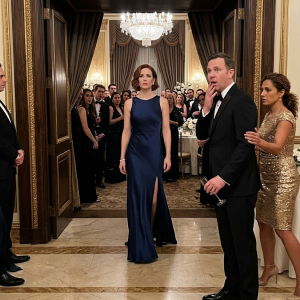
Thomas stepped out first, broad-shouldered and polished, his charcoal suit immaculate.
Victoria followed on his arm in a deep blue dress with a neckline and sheen more suited to a rooftop celebration than a house of mourning.
Neither of them looked wrecked by grief.
They looked inconvenienced by scheduling.
Thomas kissed my cheek and said he was sorry he could not stay longer at the funeral because Victoria’s party had been booked for months.
Then he asked whether I understood.
Behind him, Jennifer went visibly still.
So did Daniel Ruiz, our chief operations officer, who had been with Richard for almost thirty years.
No one spoke.
The silence itself became a judgment.
I told Thomas the will would be read at ten the next morning at Walter Harrington’s office and that all beneficiaries were expected to attend.
He lowered his voice, almost playful, and said he and Victoria were hoping to leave for Aspen that evening.
Could the paperwork wait until next week.
Richard had once told me that entitlement is most obvious when a person believes the world will pause for their comfort.
I heard that sentence in my head as clearly as if he had spoken it aloud.
I looked at my son and, perhaps for the first time in his life, gave him no room to negotiate.
Be there, I said, or the consequences will be severe.
The words landed.
He stared at me, uncertain, because he was not used to hearing steel in my voice.
Then he agreed.
He did not apologize for missing the burial.
He did not circulate among the mourners.
Victoria’s eyes drifted toward the antique vases in the foyer and the bronze sculptures Richard had collected over decades, appraising the room the way a broker appraises an estate.
Later, after the last guest left and the apartment fell into the kind of silence that only death creates, I went into our bedroom and opened the safe hidden behind Richard’s portrait.
Inside was an envelope addressed to me in his hand.
I sat on the edge of our bed before opening it because I already knew that whatever lay inside would ask something difficult of me.
The letter began