Corps as moral architecture.
He had wanted to spare us both the collision.
“Why?” I asked.
He gave me the truth.
“Because I wanted him to meet the woman I love before he met a rank he’d turn into a problem.”
That answer softened me, but not completely.
“Sunday dinner,” he said.
“That’s the invitation.”
“And your warning?”
“That it could become educational.”
I laughed.
“I’ve briefed combatant commanders and testified in front of people who came loaded for blood.
I can survive dinner with a retired gunnery sergeant.”
I believed that when I said it.
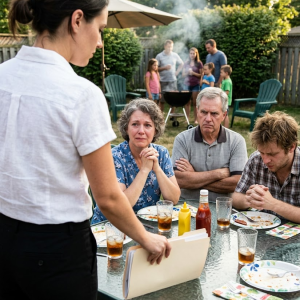
Sunday evening we drove out to his parents’ house just after sunset.
It sat in an older neighborhood shaded by tall pines, the kind of place where lawns were trimmed, shutters were painted, and every porch carried some version of the same furniture arrangement it had held for twenty years.
Inside, the house was clean, orderly, and full of Marine history.
Shadow boxes.
Framed photographs.
Challenge coins in glass.
A folded flag.
Plaques from reunions.
A sepia-toned picture of a young Frank in uniform, all sharp cheekbones and certainty.
Margaret opened the door before we knocked twice.
She was gracious in the way women become gracious when they have spent a long time managing the emotional weather of other people.
She hugged Daniel, shook my hand warmly, and said, “It’s lovely to finally meet you, Elaine.”
Frank appeared behind her a moment later, broad-shouldered even in retirement, his hair white, his face cut from old habits.
He looked me over once in the appraising way men sometimes mistake for neutrality.
“So,” he said, “Daniel tells me you’re in logistics consulting.”
“For the moment,” I said.
It was true enough to survive the first minute.
Dinner started politely.
Margaret served roast chicken, green beans, potatoes, and warm rolls.
Frank asked questions that sounded harmless until you heard what was under them.
Did I work with many military clients? Did I understand the difference between management and command? Had I ever spent much time around Marines? Each answer I gave only seemed to encourage him.
He told stories from his service with the same rhythm as sermons.
Men were harder then.
Standards were clearer.
Officers were more decisive.
The country respected the military.
The Corps had not yet softened itself to please people who had never earned the right to criticize it.
Daniel tried more than once to redirect the conversation.
Margaret interrupted with offers of more potatoes and comments about the weather.
Frank barely noticed.
He had found a subject on which he expected to remain unchallenged.
Eventually he moved from nostalgia to opinion.
That was where the tone changed.
“These days,” he said, slicing into the chicken on his plate, “half the problem is that people think leadership can be engineered.
Training slides.
consultants.
committees.
They think command is about presentation.” He glanced at me.
“It isn’t.”
I set down my fork.
He continued.
“You can’t understand command unless you’ve lived inside it.
That’s the problem with civilians.
They pick up vocabulary and think they’ve picked up authority.
But command in the Corps? That has to be earned.
It’s not handed over because the institution wants to prove a point.”
There it was.
Not just contempt, but arrangement.
In Frank’s mind, the Corps belonged