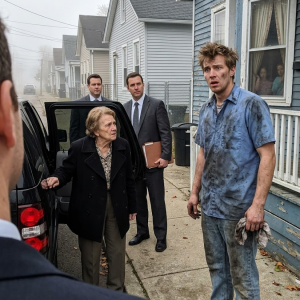
The receptionist, a woman named Gloria who had survived three principals and every species of parent drama known to public education, took one look at my face and said, “Sir, you need to leave before I call district security.”
He actually looked shocked that another adult had spoken to him like that.
Good.
He left.
I had the school add him to the no-contact list by lunch.
Ethan came next, but in his own style.
He texted.
First anger.
Then bargaining.
Then self-pity.
You don’t understand what Dad’s under.
This is too extreme.
Mom’s not sleeping.
You’re punishing everyone because you’re emotional.
I just need some time to get things together.
Can we at least talk about the house?
That last one told the truth.
Not my face. Not the slap. Not our mother. The house.
I wrote back one sentence.
Talk to my attorney.
He didn’t reply after that.
My mother waited three days.
Then she came alone.
I almost didn’t let her in, but some exhausted, stubborn part of me wanted to see what remained of her once she wasn’t sitting beside my father in a lit dining room pretending helplessness was virtue.
She stood in my apartment kitchen holding a plastic container of soup and looking smaller than I had ever seen her.
“I should have stopped him,” she said.
“Yes,” I answered.
She blinked at me, maybe expecting comfort.
I had none.
“He’s not well,” she said next.
That made me angrier than anything else.
Not because it was false.
Because it was familiar.
Every cruelty in our house had always eventually arrived wearing the mask of my father’s stress, my father’s pride, my father’s disappointment, my father’s burdens. Everyone else bled around those things and called it loyalty.
“He was well enough to hit me,” I said.
She started crying again.
I did not hold her.
I did not reach across the table and become the daughter she had trained me to be by always cleaning up after the louder people.
Instead, I asked her the only question that mattered.
“When did you know about the foreclosure?”
She looked down.
“Six months.”
That sat there between us like an organ on a tray.
Six months.
Six months of notices.
Six months of lies.
Six months of watching me save, budget, plan, dream about a first home while the house I was already standing inside slipped toward auction.
“Why didn’t you tell me?”
Her answer was so honest I almost hated her more for it.
“Because I knew you’d be the only one who could fix it.”
There it was.
The whole family in one sentence.
Not love.
Faith in utility.
I told her to leave.
She did.
The month that followed was uglier than I hoped and cleaner than I expected.
My father fought the protective order and lost.
Not because he seemed terrifying in court, but because judges tend to take a dim view of men who strike adult daughters in property disputes and then show up at their workplaces to continue the intimidation.
The judge extended the order for six months and required no direct contact.
That solved one problem.
The house solved another.
Once they understood I was not bluffing, things became practical fast.
Ethan moved out first, dragging boxes into the driveway and muttering that I was enjoying this. He left behind unpaid storage invoices, two broken desk chairs, and three bins of failed startup merchandise he apparently thought would someday become valuable.