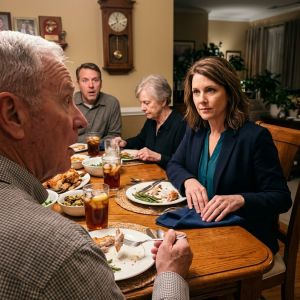
asked whether Liam truly wanted to throw away the protection the family had built around him.
Liam repeated the word protection and laughed once with no humor in it at all.
What Charles meant, he said, was shame.
Evelyn closed her eyes as though she had been waiting years to hear someone say the word aloud.
Then she turned to Elena, and whatever authority she usually wore slipped.
She apologized.
Not with the polished regret of wealthy people who are sorry mainly for inconvenience, but with a ragged honesty Elena had not expected.
She said she had convinced herself this arrangement could repair two wounds at once.
She had watched Liam disappear into silence after the fire.
She had watched Elena move through the house with quiet competence, kindness toward every staff member, patience even on bad days, and she had thought perhaps goodness could be arranged where love could not.
The villa deed, she added, had already been prepared in Elena’s name.
Charles had not known she filed it the previous afternoon.
Charles called it sentimental nonsense.
Evelyn answered with a steadiness that made Elena understand, for the first time, how much of the family’s cold order had survived only because Evelyn kept swallowing what she knew was wrong.
She said the deed was legal.
She said Liam’s trust reverted to him in full when he turned thirty, which would happen in six weeks.
She said Charles no longer had the right to decide whether their son existed as a person or a secret.
Charles left the room with the folder still on the table, promising consequences in the tone of a man unaccustomed to resistance.
The moment the door closed, the suite felt larger.
Elena could have taken the villa and walked away then.
No one would have blamed her.
Instead she sat across from Liam in the strange daylight of a marriage that had begun as a transaction and become something else overnight.
She told him she would not stay because of pity, and she would not leave because of fear.
If they were to remain husband and wife, even for a day longer, everything from that moment forward had to be honest.
Liam nodded as if the condition cost him and relieved him at the same time.
Then, for the first time since the wedding, he smiled without bitterness.
It changed his whole face.
Over the next week, honesty arrived in pieces.
Liam showed her the east wing where he had spent years hiding in plain sight.
There was the locked music room with the grand piano she had heard at night, the indoor pool he used for physical therapy when the house slept, the greenhouse where he grew lemons because the scent reminded him of Italy, though he had only visited once as a child.
He walked with a slight stiffness on damp mornings and sometimes pressed his palm against his thigh when the old grafts tightened.
Elena learned which ointments helped, which subjects made him withdraw, which silences meant pain and which meant peace.
She, in turn, told him the parts of her life no employer had ever asked about.
She told him how her mother, Sofia, had worked double shifts at a diner after the fire because insurance paid too little and grief