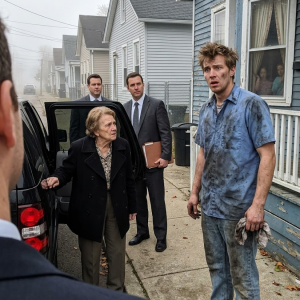
Not Nate’s face.
The gloves.
His whole mouth tightened like something inside him had just broken.
“Nate,” he said.
My nephew—his son—did not move at first.
Then he said, “Did you really steal from Grandpa?”
Aaron closed his eyes.
“No,” he said. “I swear to God, no.”
Nate looked at him for a very long time. Then he asked the question that mattered more.
“Did you leave me?”
Aaron cried then.
No performance.
No masculinity left intact.
Just grief.
“I tried not to,” he said. “I just didn’t know how to fight your grandfather and still find you.”
That was not forgiveness.
But it was truth.
And truth, I learned that summer, was not healing by itself.
It was just the first room healing could enter.
Nate stayed with us through the fall.
Then the winter.
Then the rest of the school year.
The temporary placement became foster kinship care, then legal guardianship while the criminal case moved. Aaron did not fight that. He came every other weekend at first, then more often once Nate wanted it. Therapy stayed nonnegotiable. School support too. Gloves slowly became lighter, then fingerless, then gone only inside the house, then gone in the backyard after dark, then gone in daylight one afternoon while he was helping me plant tomatoes like it wasn’t the bravest thing he’d ever done.
The first time Lila saw him carry a watering can barehanded, she walked back into the kitchen and cried so hard she scared the dog.
The trial was small-town ugly.
Church people showed up for my parents in pressed clothes and tragic faces, as if age and hymns should soften what was carved into a child’s body. My father’s lawyer tried discipline. Tried grief. Tried the old language about “troubled boys” and “misunderstood correction.”
The prosecutor laid the photographs down one by one.
That ended discipline.
My father was convicted.
So was my mother, though for less. She did not carve the words, but she upheld the world that made them possible, and the law finally named that too. She cried at sentencing and kept saying, “I never touched him.”
Maybe she thought that still meant innocence.
It didn’t.
My sister never faced court.
She had died in a car wreck before any of this surfaced. For months, that fact sat in me like a stone I couldn’t swallow. Grief is hard enough. Grief mixed with betrayal feels like poisoning your own memories one by one.
I had loved her.
I had also buried a woman who watched the first cut happen and said maybe he needed to learn.
Both things were true.
It took me a long time to understand that truth does not honor the dead by getting gentler after they’re gone.
It just gets lonelier.
By the next summer, Nate was different.
Not fixed.
That word is too simple for children who’ve had to survive being taught to hate themselves.
But different.
He laughed without checking first.
He slept through the night most nights.
He stopped washing his hands until they bled.
The scars remained, white and crooked and permanent, but he no longer hid them from us. Sometimes he still wore gloves in public when the world felt too sharp. We let him. Healing that survives tends to hate being rushed.
One evening in August, we were grilling in the backyard when he came out in a T-shirt and no gloves at all. Just his hands, visible in the late orange light, holding a plate of corn like it was nothing.