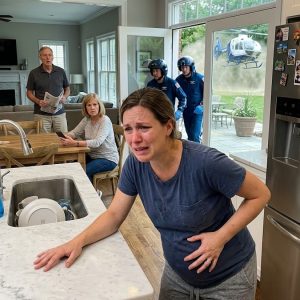
Another contraction tore through me, sharper this time, deep and crushing. My knees buckled and I grabbed the edge of the counter so hard my fingers slipped.
“Mom, please.”
She exhaled as if I were testing her patience on purpose.
“Oh for heaven’s sake. Sit down if you want attention, but I am not canceling on your sister because you’re uncomfortable.”
I turned toward the living room, panic rising so fast it made my vision blur. My father sat in his armchair with the newspaper open, glasses low on his nose.
“Dad,” I gasped. “Please call an ambulance.”
He didn’t even stand.
He lowered one corner of the paper, looked at me for half a second, then said, “Your doctor’s office is only twenty minutes away. People rush to hospitals for everything now. You’re probably overreacting.”
I stared at him, unable to believe what I was hearing.
A warm rush ran down my legs.
My water had broken.
That was the moment fear stopped being abstract. My whole body started shaking. I was crying now, not from pain alone but from the brutal clarity of what was happening: the two people who should have helped me were more annoyed than alarmed.
“Please,” I whispered.
My mother took her purse from the counter and checked her lipstick in the microwave door reflection.
“You always choose the worst timing,” she muttered.
Then the sound came.
At first it was faint, like distant thunder.
Then louder.
Faster.
A heavy rhythmic chopping that made the windows tremble inside their frames.
My father finally lowered the newspaper all the way.
My mother turned toward the back door, frowning.
The noise swallowed the room.
I remember the light shifting first, shadows jumping across the walls. Then the dishes on the shelf rattled. Then the backyard trees bent hard in one direction.
My mother rushed to the window and froze.
My father stood so quickly the newspaper slid to the floor.
I forced myself upright and looked past them through the glass.
A helicopter was descending into their backyard.
Not circling.
Not passing over.
Landing.
Grass and dirt exploded beneath the rotors. My mother’s hydrangeas flattened instantly. Patio cushions flew across the deck. The white table umbrella snapped sideways.
My mother turned to me, stunned. “What is this?”
I already knew.
Tears blurred my eyes as the helicopter settled lower, sleek and dark against the fading afternoon sky, emergency markings visible near the tail. Within seconds, two uniformed medics and a flight crew member jumped out and ran toward the house with practiced speed.
Someone pounded on the back door.
My father opened it, speechless.
The lead medic stepped inside wearing a headset and carrying a trauma bag. “Amelia Cole?” he asked sharply.
I lifted my hand.
“We’re here for you, ma’am. Your husband authorized immediate transfer.”
My mother looked from him to me, then back to the helicopter as if reality had slipped on a hidden step.
“Authorized?” she repeated.
The medic was already kneeling beside me, checking my pulse, asking about contractions, due date, water break, fetal movement. Another medic opened a portable monitor while the crew member spoke into a radio clipped to his vest.
Everything happened in a blur of competence.
Questions. Straps. Blood pressure cuff. Oxygen. Calm voices.
My mother kept trying to interrupt.