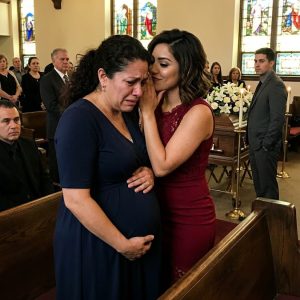
But he had done something at the end.
He had made sure Vanessa could not bury me under the same version of events she had used for years.
The state reopened my mother’s case that afternoon.
Vanessa was arrested three days later.
She came out of her condo in sunglasses and a camel coat, still trying to look composed for the cameras someone had tipped off. They photographed her getting into the cruiser anyway. Her attorney called the charges a tragic misinterpretation of family grief. The prosecutor called them what they were: financial exploitation of a vulnerable adult, estate fraud, theft, and negligent homicide related to the death of Patricia Carter, pending grand jury review on the final count.
The town reacted exactly as towns do.
Half the people said they always suspected something was wrong.
The other half said they could not believe a daughter would do that.
I hated both groups equally.
The first because suspicion without action is vanity.
The second because disbelief is often just admiration refusing to die on schedule.
The criminal case took nearly a year.
Vanessa fought every inch of it.
She challenged the recording. Claimed Dad was coercive. Claimed Mom had been unstable. Claimed the old thefts were just family reimbursements poorly documented. Claimed I was weaponizing probate because I had always resented her.
She looked beautiful through most of it.
That sounds petty, but it mattered.
Beautiful people are often granted extra inches of doubt by systems built from appearances.
But the evidence did not care how symmetrical her face was.
The ledger held.
The trust withdrawals held.
The bracelet sale held.
The audio held.
A retired banker testified that Richard Carter privately requested duplicate statements after suspecting “internal theft by a family member.” A former bookkeeper from my mother’s charity confirmed discrepancies Vanessa had no authority to make. Detective Mayfield testified to Dad’s off-record approach years earlier and his renewed cooperation before death. And in the ugliest moment of the trial, the state played Vanessa’s own voice saying, “I didn’t mean for her head to hit.”
That sentence changed the air in the courtroom the way my father’s clause had changed it in probate.
After that, nothing she said sounded like a misunderstanding anymore.
It sounded like strategy.
The verdict came in on a wet Thursday in March.
Guilty on estate fraud.
Guilty on theft from a vulnerable adult.
Guilty on unlawful conversion of trust assets.
Guilty on negligent homicide in the death of Patricia Carter.
When the clerk read the last one, Vanessa did not cry.
Neither did I.
She just stared straight ahead, as if grief, shame, and disbelief had all finally discovered there was no room left inside her for any of them.
I wish I could tell you I felt victorious.
I did not.
Justice is not the same thing as relief, and relief is not the same thing as healing.
What I felt was something flatter and more useful.
The end of distortion.
The end of her version being the loudest one in the room.
The probate matter resolved quietly after that.
The court voided Vanessa’s petition entirely. Dad’s revised will was admitted in full. Judith, at my request, petitioned to have a neutral fiduciary review the estate before distribution, and the judge approved it immediately. I inherited the house, what remained of Dad’s retirement accounts, and the lake property no one in our family had visited willingly since my mother died.