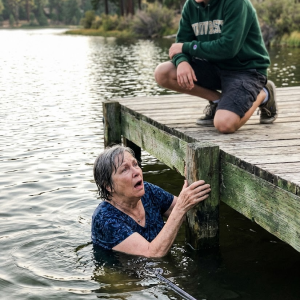
For the first few minutes after Michael and Emily walked away, I stayed exactly as I had fallen, cheek pressed to wet pine needles, one arm pinned beneath me, mouth full of dirt and blood.
The instinct to call after them came in waves.
So did the instinct to deny what I had heard.
A mother can survive many humiliations.
The one thing she is slowest to survive is the moment she understands her child has measured her life and found it inconvenient.
I kept my eyes closed and counted my breaths until the footsteps above me vanished completely.
Then I listened for Aiden.
At first I heard only wind moving through the branches and the hammering inside my skull.
Then, somewhere lower on the slope, came a small whimper.
Not loud.
Not dramatic.
Just the frightened sound of a child waking into pain.
I rolled onto my back and nearly blacked out.
My left arm screamed.
Later I learned it was fractured in two places.
At that moment it felt as if the entire side of my body had been torn loose.
I dug my heels into the dirt and forced myself to pivot downhill.
Aiden had not fallen all the way to the ravine floor.
The carrier had snagged on a cluster of young aspens and dumped him sideways into a patch of brush about fifteen feet from me.
His forehead was bruised, one shoe was missing, and his little face was white with shock, but he was breathing.
His eyes fluttered when I reached him.
He looked at me without understanding and asked for his mother.
That nearly broke me more than the fall had.
I told him Grandma was there.
I told him he had to be brave for me.
I told him the same thing again and again because it was the only steady sound I could make.
My phone was gone.
My backpack had torn open somewhere on the descent.
I found my jacket caught on a rock and wrapped it around him, then used the strap from the carrier to pull him closer while I crawled.
Every movement hurt.
The ravine smelled of sap and cold mud.
The strip of sky above us kept narrowing as afternoon clouds rolled in.
I knew enough about mountain weather to understand that if darkness came before help did, the danger would change from broken bones to something quieter and less merciful.
What saved us was not luck alone.
Michael had packed an emergency whistle for Aiden on the carrier strap because Colorado parenting, as Emily liked to say, meant preparing for everything.
He had prepared for everything except me surviving him.
I found the whistle with numb fingers and blew until my vision sparkled.
Then I rested and blew again.
The sound was thin in all that open space, but it carried.
Nearly an hour later, another whistle answered from above.
A volunteer ranger named Tom Willis and a trail runner who had heard him searching reached us just before the temperature dropped.
I remember the trail runner’s orange hat before I remember his face.
I remember Tom kneeling beside Aiden first, then turning to me with the expression professionals wear when they are trying not to let fear cross their features.
They got us into