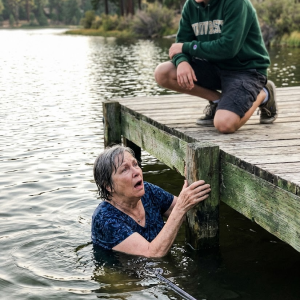
blankets, radioed for the rescue team, and asked what happened.
I said the bare minimum because every extra word made the world tilt.
I told them my son and daughter-in-law had left us.
I told them it was not an accident.
Then I passed out.
I woke in the hospital under bright lights that made everything look bleached and unreal.
My shoulder had been reset.
My arm was casted.
Two ribs were cracked, and I had a concussion severe enough that the neurologist warned me memory might come back in fragments.
Aiden was in pediatrics with a concussion, a sprained ankle, and a broken collarbone.
When the nurse told me he was going to recover fully, I cried so hard my IV alarm started beeping.
Michael and Emily arrived before the police did.
They came into my room holding each other and wearing expressions that would once have convinced me.
Michael’s face was blotched red.
Emily looked pale enough to disappear into the wall.
He started toward my bed, saying he thought I was dead, that he had run for help, that everything happened too fast.
But the second our eyes met, the performance cracked.
It was only a flicker.
One small hard flash of calculation.
He was not shocked that I was alive.
He was shocked that I was conscious.
I asked the nurse to call security and requested detectives before I spoke to either of them again.
Detective Lena Ortiz took my first statement that night.
I told her about the fall, the footsteps, the way Emily had asked if I was dead, and Michael’s voice answering that if I was breathing they could not take that risk.
I repeated the part about the money twice because I needed someone besides me to carry it.
Ortiz listened without interrupting.
She took notes, asked careful questions, and did not promise me anything she could not deliver.
That restraint made me trust her more, not less.
Michael and Emily gave a different version.
The trail had crumbled.
Emily had nearly fallen too.
Michael had gone to find cell service.
Emily had panicked and followed him.
They insisted they believed we had tumbled much farther and were already dead by the time they reached help.
It was a cowardly story, but a usable one.
People do irrational things in the wilderness.
People freeze.
People flee.
And when there are no witnesses, fear can look an awful lot like innocence.
What complicated their story was Aiden.
He was only four, dazed and exhausted, but children sometimes carry truth in pieces adults underestimate.
When the hospital social worker asked him where he got hurt, he said Mommy turned around, Grandma fell, Daddy was mad, and everyone had to be quiet.
That was not enough for a prosecution.
It was enough for child services to pay attention.
When Emily later tried to explain to the caseworker that Aiden was confused, she did it with such brittle irritation that she only made herself look worse.
My late husband had left behind more than grief.
He had left an estate, several rental properties, and a family trust.
Michael had always assumed he would one day slide naturally into control of it.
But during the last year of my husband’s illness, several odd transactions had surfaced.
Requests