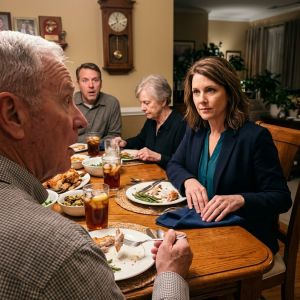
Then he got up the next morning and made breakfast because Ethan still needed pancakes and a lunchbox, and life, even after justice, insisted on ordinary things.
Emma offered him a position at Hawthorne Tech as Director of Learning Design.
He refused twice before finally agreeing on two conditions: he would build tools that actually respected how children learned, and he would still spend time teaching real students every week so the work never drifted into theory alone.
Emma accepted immediately.
Hawthorne Tech canceled every trace of the Webb branding and rebuilt the platform around Daniel’s original framework.
They named the new initiative Carter Learning and launched it first in underfunded districts that had been priced out of better intervention tools.
Emma insisted on scholarship access.
Daniel insisted the teacher training include emotional safety, not just technique.
At home, the changes were quieter and in some ways harder.
Lucas did not transform overnight into an uncomplicatedly happy child.
Grief is not a switch you flip.
But he began returning to himself in visible pieces.
He laughed more often.
He stopped calling himself stupid.
He started bringing his homework to the kitchen table and arguing with Daniel about probability puzzles while Ethan corrected everyone’s spelling with delighted seriousness.
Emma had her own work to do.
One night Lucas asked her, very plainly, why she had been gone all the time even when she was in the house.
It was the kind of question children ask when they are tired of protecting adults from honest answers.
Emma told him the truth.
Because losing your dad hurt so much that I thought if I kept moving, maybe it would stop hurting, she said.
And instead I disappeared.
I’m sorry.
Lucas did not answer right away.
Then he climbed into her lap in the most unselfconscious way, as if some younger version of him had briefly returned, and said he missed her when she was only one room away.
That sentence changed her more than any boardroom victory ever had.
She cut travel.
She moved breakfast to the family calendar as if it were an investor meeting.
She attended school conferences herself.
She let the study reopen fully instead of preserving it as a shrine.
It became a living room again, then a homework room, then the place where Lucas and Ethan built towers out of cards and argued over logic games while Daniel wrote lesson designs at James’s old desk.
What grew between Emma and Daniel did not happen with dramatic declarations.
It happened in increments too quiet for anyone outside the house to notice at first.
Shared coffee before sunrise.
Evenings in the garden after the boys were asleep.
Long conversations about children, ambition, failure, and the strange shame of surviving public grief.
Trust returned to Daniel slowly because betrayal had once cost him almost everything.
Emma understood that slowness.
She had her own ruins.
A year after the day she found him in the study, Hawthorne Tech hosted a small pilot celebration at an elementary school using Carter Learning.
The event was not flashy.
Daniel wanted children present, not cameras.
In one classroom, a girl who had been on the verge of repeating third grade stood at the board and explained fractions using colored tiles and hand motions with absolute confidence.