was no romantic reunion.
Some stories earn that ending; theirs did not.
Lucas had loved Elodie once, but love without courage had left damage that apology could not erase.
He knew that.
To his credit, he stopped trying to frame parenthood as a path back to her.
Instead he learned the harder lesson: that remorse is not a speech, it is behavior repeated until others can rest inside it.
Over time, Elodie let the boys spend afternoons with him unsupervised, then whole Saturdays.
He took them to the aquarium and sent back blurry photos of Leo pressing his nose to the glass and Oliver trying to name every shark.
He showed up for preschool performances and parent meetings.
When one of the boys got a fever during his weekend, he called Elodie immediately, followed the dosing instructions exactly, and sat up all night with a cool cloth.
Trust did not bloom.
It accumulated.
By the twins’ fifth birthday, the new shape of the family had become imperfect but real.
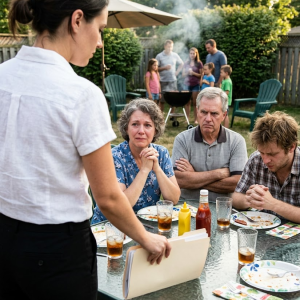
Sarah hosted the party in her backyard because she claimed her fence was emotionally stronger than any event venue.
Paper streamers hung crookedly between two trees.
A supermarket cake leaned slightly to one side in the heat.
Children ran in circles with frosting on their faces.
Lucas arrived early with a gift that was refreshingly modest: a train set he had chosen only after confirming with Elodie that neither boy already owned it.
He helped tape balloons, burned his hand slightly lighting the grill, and let Oliver boss him around during the setup with ruthless efficiency.
Leo, who had once hidden behind Elodie’s knees during visits, now pulled Lucas by the wrist toward the picnic table to show him a new dinosaur book.
Elodie stood back for a moment and watched the scene.
It was not the life she had imagined when she was young enough to believe love would be enough.
It was messier, sadder in some places, stronger in others.
Across the yard, Lucas looked up and met her eyes.
There was gratitude there and regret and something quieter than either, the understanding that he had been allowed to build a place in his sons’ lives but not reclaim the years he had lost.
Elodie nodded once.
That was all.
It was enough.
When the candles were lit, Leo and Oliver insisted on standing shoulder to shoulder to blow them out together.
Sarah counted down dramatically.
The boys leaned in, cheeks puffed, and the flames vanished in one bright breath.
Lucas was in the photograph taken a second later, not because his last name demanded inclusion, but because he had earned a place at the table.
Victoria was nowhere in the frame, nowhere in the yard, nowhere in the life that had gone on without her permission.
Later that night, after the wrapping paper had been cleared and the twins had fallen asleep side by side, Elodie looked at the picture on her phone.
The invitation meant to shame her had done the opposite.
It had exposed a cruel woman, stopped a false marriage before it began, returned a father to the truth he had failed to protect, and placed her sons exactly where they always belonged: in the center of the story, impossible to deny.
She turned off