I was working as a housemaid in the Hamilton mansion in Connecticut when Mrs. Hamilton called me into her study and changed the direction of my life in a single sentence.
“Elena,” she said, folding her hands over a leather blotter, “I want you to marry my son.”
For a second, I thought I had misheard her.
I stood there in my cleaning uniform with a basket of pressed linens against my stomach, staring at the woman who paid my wages, fed half my family through those wages, and had never once spoken to me like I was anything more than a useful shadow.
She kept talking calmly, as if she were discussing property taxes.
“You’ve heard the rumors,” she said. “People say Liam is disabled. Some say he was badly injured. Some say worse. If you agree to become his wife and remain loyal to him, I will transfer a villa worth two million dollars into your name.”
The room went silent after that.
I could hear the clock on the mantel.
I could hear my own breathing.
And beneath everything else, I could hear my mother coughing in memory from our apartment across town, the one that smelled like medicine and boiled rice because every extra dollar in our house went to keeping her alive.
My family was drowning.
Medical bills.
Late rent.
Two younger brothers pretending not to be hungry.
A future that kept shrinking no matter how hard I worked.
So yes, the number hit me.
But the price hit harder.
Marry a man I had never met.
A man hidden inside his own family’s house.
A man people whispered about but no one seemed to truly know.
I should have said no.
Instead, I asked, “Does he know?”
Mrs. Hamilton paused.
Then she said, “He knows enough.”
That answer sat wrong in my chest from the very beginning.
Still, I agreed.
Not because I was greedy.
Because desperation changes the shape of dignity. It makes impossible things sound practical when your family is already sinking.
The wedding was arranged quickly and quietly, with the kind of polished restraint rich families use when they want scandal to look elegant from a distance.
That was the day I first saw Liam.
He sat at the front of the ceremony hall in a wheelchair, wearing a dark tailored suit, posture straight, hands folded, expression unreadable. He wasn’t frightening. That made it harder. He was handsome in a restrained, distant way, with pale blue eyes and the sort of sadness that made him look like a man who had been left alone in plain sight for a very long time.
Even stranger, despite the warmth of the room, he wore heavy formal trousers that fully covered both legs.
The guests whispered anyway.
“Such a shame.”
“I heard he can’t walk at all.”
“No, I heard the accident ruined him.”
“They keep him hidden for a reason.”
I heard every word and kept my face still.
When I reached the altar, Liam looked up at me for the first time. I expected resentment. Pity. Even humiliation.
What I saw instead was caution.
As if he were the one being traded, not me.
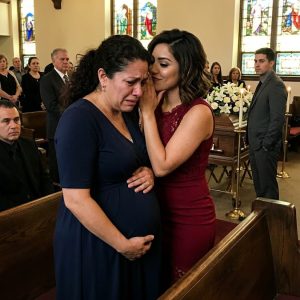
The ceremony passed in a blur of vows, white flowers, careful smiles, and expensive silence. Mrs. Hamilton cried at exactly the right moments. A few women from the household looked at me with envy because all they saw was the villa, not the trap.