The first thing Mason forgot when he saw me was how to breathe.
I was close enough to watch it happen in stages.
The easy smile he had been wearing for the photographer fell first.
Then his hand slipped from Avery Langford’s waist.
Then his throat moved once, uselessly, like his body was trying to force sound through panic and finding none.
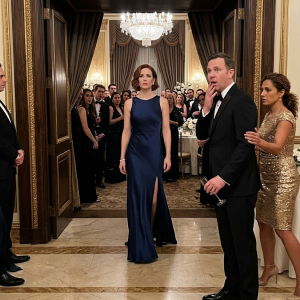
For one long second, the foyer outside the Crawford Hotel ballroom belonged only to the two of us.
My little brother in midnight-blue velvet, raised his whole life to believe the world would cushion every fall.
And me in white silk I had drafted, cut, fitted, and finished myself, the daughter they once pushed into a blizzard and called a liability.
“Congratulations, Mason,” I said.
My voice did not shake.
That, more than anything, made fear enter his face.
The old version of me had trembled under his cruelty.
The old version of me had flinched when he sharpened his words just to see whether they landed.
The woman standing in front of him now had built a life that no longer depended on whether a Harper approved of her.
His eyes moved over me, trying to solve me.
The dress.
My face.
My posture.
Then finally the detail over my heart: V.
VALE, hand-embroidered in pearl silk so subtle it vanished in shadow and gleamed in light.
It caught the chandelier glow at exactly the wrong time for him.
I saw recognition strike.
Not because he followed fashion.
Mason followed power, not craft.
But Avery followed fashion, and for the last six months her name had been attached to one particular obsession: securing a gown from V.
Vale Atelier.
The impossible bridal label.
The designer who kept interviews brief, appearances rare, and waitlists long enough to feel like punishment.
Avery turned toward him, still smiling, still certain she stood in an ordinary interruption.
“Mason?” she asked.
“Do you know her?”
He looked at her and then back at me.
He still could not answer.
That was when my mother dropped the champagne.
Laura Harper had been crossing the marble with the graceful urgency of a woman always moving toward the next person who could be useful to know.
Diamonds flashed at her wrists.
Her silver heels clicked against the floor.
Her expression had been fixed in that polished, social smile she wore the way some women wear perfume.
Then she saw me.
Both flutes slipped from her hands.
The crash was hard and bright and violent in the silence that followed.
Crystal scattered across the marble.
Champagne splashed over the hem of her pale dress.
The quartet inside the ballroom faltered mid-phrase.
Conversations died by instinct.
Every head turned.
My father stepped out from behind her and went still.
Richard Harper had not become a softer man with age.
Time had only made him more careful about where he placed his cruelty.
His hair had silvered.
His face had thickened under the skin.
But his eyes were unchanged: cold, appraising, almost proud of their own hardness.
Except not then.
Then they were terrified.
The fear was not personal.
It was structural.
He was looking at me the way a man looks at a crack that has finally reached the load-bearing wall.
I let them look.
I had