she saw her surname on a glass wall for something she had built rather than survived.
She returned to Linda’s house only once.
Her attorney came with her, and so did a court officer.
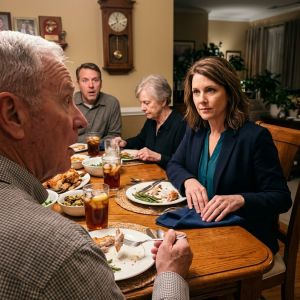
Linda, suddenly smaller without control to inflate her, signed over the last box of Felicia’s father’s belongings: a watch, an old flannel shirt, three letters he had written during hospital treatments, and a library card with Felicia’s name in childish handwriting.
Clare would not meet her eyes.
On the porch, Linda began to say she had done her best.
Felicia stopped her with a calm she had earned the hard way.
“You gave me shelter,” she said.
“You never gave me home.” Then she walked away, and nothing in her looked back.
The trial ended in late summer.
Damian was convicted.
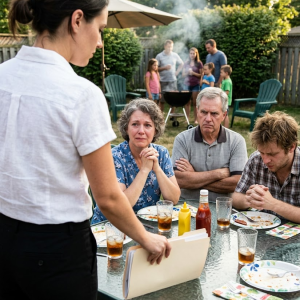
Linda and Clare accepted plea deals that kept them out of prison but under restitution orders, supervision, and permanent distance from Felicia.
When reporters asked for a comment outside the courthouse, she gave them none.
She had spent too many years being turned into a story by other people.
Some endings deserved privacy.
That night Alexander brought takeout to her apartment because neither of them wanted a celebratory restaurant.
They ate on the floor among boxes of legal paperwork and laughed until the relief turned strange and soft.
Then he asked, very carefully, “What do you want now?” This time she had an answer ready.
“Peace,” she said.
“Work that matters.
And you, if you still mean it.” He kissed her like a man who understood the cost of being chosen.
A year after the first false engagement, Reeves Tech and the city library launched the Hart-Reeves Fellowship for self-taught programmers and disabled technologists.
The ceremony took place after hours among the stacks where Felicia had once hidden from rain and family and failure.
When the guests had gone and the librarians were pretending not to watch, Alexander rolled with her between the shelves and stopped in front of the computers where she used to study until closing.
“No board pressure,” he said.
“No contract.
No scheme.
Just a question.” He held out a ring, simple and luminous in the library light.
“Felicia Hart, what do you want?” She laughed through tears.
“You know the answer now.” “I do,” he said.
“I still want to hear you say it.” So she did.
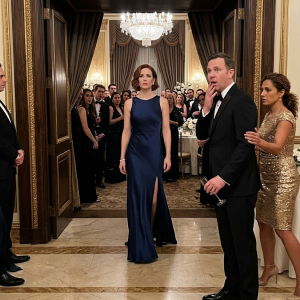
They married six weeks later in the library courtyard at dusk, with Mina as witness, a few loyal friends, and not a single clause beyond the ones the state required.
Felicia wore ivory, Alexander wore charcoal, and when the officiant placed the license in front of them, her hand was steady.
The first paper she had ever signed in front of family and power without fear was the one she had chosen for herself.
Afterward they drove past the Grand Meridian Hotel, where the lights on the thirty-second floor glowed against the night.
Alexander glanced up, then at her, and smiled.
Once, he had noticed a shy cleaner no one saw.
Now the woman beside him had rebuilt the systems around them, kept him alive, changed his company, and chosen him in return.
Nothing about her was invisible anymore, and nothing about their ending was unfinished.