not yet a legend to anybody.
Before bed she called her mother.
Sarah cried when Maya described the escort and the message from the pilots, but for the first time in a long while, the crying did not sound only broken.
It sounded mixed with pride.
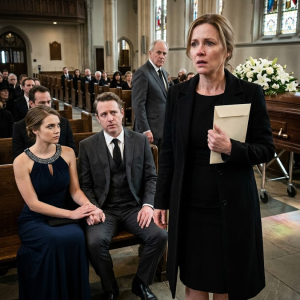
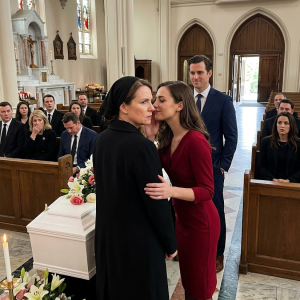
The memorial took place the following afternoon in a large hangar space dressed with rows of chairs, flags, photographs, and a screen that showed images from different parts of her father’s career.
Uniformed men and women filled the room alongside civilians, old friends, neighbors, and family.
Maya wore a simple dark dress.
The dog tag remained around her neck, but this time she did not hide it.
The silver wings in their case rested on a table near the front beside a framed portrait of her father smiling in uniform.
Major Rick Chin arrived in flight suit, broad-shouldered and serious, but his face softened the instant he saw Maya.
Captain Lisa Martinez came beside him, compact and alert, carrying herself with the easy precision of someone trained to move through pressure.
They introduced themselves quietly before the service began.
Chin told Maya he had been honored to fly with her father once.
Martinez told her there were more pilots in the world than she could count who still owed pieces of their careers to Falcon Reynolds.
Neither speech sounded rehearsed.
That made them easier to trust.
When the formal remarks started, several officers spoke about James Reynolds the way institutions speak about the dead: with accuracy, respect, and the necessary list of accomplishments.
Then Chin stepped up, and the room changed.
He did not begin with medals.
He began with failure.
He told the audience that the first time he really met Falcon, he had just flown badly and was sure his career was beginning to slide.
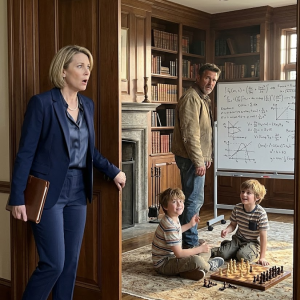
Instead of humiliating him in front of others, Falcon stayed after dark, drew diagrams on a board, and taught him how to see what fear had hidden from him.
Chin said that every hard mission he had completed since then contained a little bit of that night.
A pilot can borrow steadiness from another pilot, he said, and your father gave me some of his.
Martinez spoke after him.
She told a different story, one Maya had never heard.
Years before she ever touched the controls of an F-22, she was a cadet listening to people talk as though women should be grateful for whatever corners of military aviation they were allowed to occupy.
Falcon overheard, corrected them without drama, and then followed that correction with action by writing a recommendation that helped open a door.
Martinez said she did not know at the time how unusual it was for a respected combat pilot to spend reputation on somebody with no rank and no influence.
She knew now.
Then she looked directly at Maya and said that James Reynolds had not just protected airspace.
He had protected possibility.
After the formal speeches, an older crew chief named Henry Barnes approached Maya with eyes that looked both tired and kind.
He had worked with her father on and off for years.
From a breast pocket he took a small photograph that had been kept in a protective sleeve.
It showed Maya at about age eight, gap-toothed and grinning,