I hated wasted movement in an operating room. Then a newspaper used it after a winter bus crash when my team and I spent eleven straight hours stitching broken people back together. I never liked the drama of it. Surgeons who believe their own mythology become dangerous. But I would be lying if I said I didn’t understand, in that moment, why the name unsettled people. It reminded them I had once been very hard to fool.
Three years earlier, after my wife Anna died, I stopped operating for good.
Retirement had already begun to pull at me by then. My hands were still steady, but grief changes the shape of time. The house became too large in strange ways after Anna was gone. Not emptier exactly. Sharper. Every room contained a memory with edges on it. Her reading glasses on the tray in the den. Her gardening clogs under the mudroom bench. The peach dish she always used for cherry tomatoes in summer. I learned that silence can be louder than some emergencies.
Melissa started visiting more after the funeral. At first, I was grateful.
She brought soup, rearranged flowers, sat with me on the porch, and talked about small things. Her marriage to Gregory was still relatively new then. He worked in commercial development, spoke in confident rectangles about value and growth, and always seemed to look at every room as if estimating what could be extracted from it. He was unfailingly polite to me, which should have been more reassuring than it was. Some people are most dangerous exactly when they are being careful.
He began asking questions that didn’t sound like questions. Was the lake house fully paid off? Did the patent royalties still come in quarterly? Had I updated the trust since Anna passed? Wouldn’t it be simpler if Melissa had broader authority in case of an emergency? The first few times, I answered vaguely. By the fifth or sixth time, I stopped answering at all.
What made me suspicious wasn’t one big thing. It was the accumulation of small, wrong details.
A pill organizer I kept on the kitchen counter turned up in the pantry behind canned soup. My appointment book disappeared two days before a cardiology checkup, then reappeared under a stack of gardening catalogs. A burner I knew I had switched off was found on low after Gregory had spent ten minutes alone in the kitchen. Melissa arrived more and more often not with concern but with evidence. Her language changed too. She stopped saying, ‘Dad, are you okay?’ and started saying, ‘Dad, this is exactly what we’re worried about.’
Then, one rainy Thursday, I slipped on the stone path behind the house and bruised my hip.
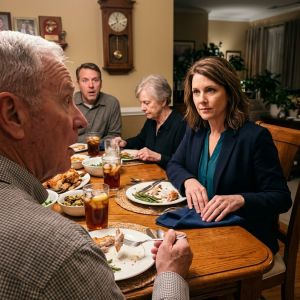
I wasn’t badly hurt. Embarrassed, yes. Sore for a week. But by that evening Melissa was crying in my living room and Gregory was talking about assisted living as though I had been found wandering interstate traffic. He drafted a power of attorney packet before the bruise had even yellowed. He set it on my dining table with a pen and said, in a voice smooth as glass, ‘This just makes things easier for everyone.’
Nothing in medicine ever taught me to trust a man who wanted a signature before the swelling had gone down.