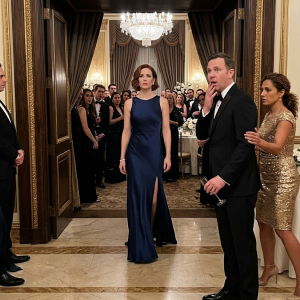
Bell to step inside.
She apologized for the intrusion, but her expression suggested she had no intention of waiting until morning.
“I need clarity before the board departs,” she said.
“Ms.
Carter, may I ask directly whether Ms.
Lauren Carter misrepresented her role in securing this venue?”
“Yes,” I said.
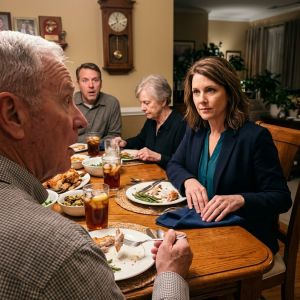
Margaret turned to Lauren.
“And is it true that you instructed security to remove Ms.
Carter from the property before verifying anything at all?”
Lauren’s silence was answer enough.
Margaret inclined her head once, disappointed rather than surprised.
“Then your committee appointment is withdrawn effective immediately.
Haversham’s work depends on dignity.
We cannot ask the public to fund that principle while rewarding the opposite.”
Lauren looked at my mother as if waiting for rescue.
None came.
Margaret thanked me, left the room, and closed the door behind her.
No one spoke for several seconds.
Finally my father put the papers down.
“What do you want from us?” he asked.
I thought about that carefully.
There had been a time when I would have answered differently.
I might have said respect.
Curiosity.
Accountability.
A real apology.
I might have asked for the impossible miracle of being seen by the people who had known me longest.
But the truth was simpler than that now.
“I want distance,” I said.
“I want honesty, if we speak again.
And I want you to understand that access to me, my work, and my name is no longer something you get automatically.”
My mother flinched as though the sentence had physical force.
“You can’t mean that.”
“I do.”
Lauren’s voice dropped to a whisper.
“Over a hotel?”
I looked around the Blue Room, at the velvet, the city lights, the building I had saved and then rebuilt into something strong enough to hold other people safely.
“No,” I said.
“Over a lifetime of being treated as less than I am.”
Marcus escorted them out through the mezzanine corridor five minutes later.
Not roughly.
Not theatrically.
Just cleanly, the way a good hotel handles anything that could become a mess if left unattended.
They left through a side exit reserved for private departures.
No crowd.
No spectacle.
Only consequences.
I stood alone for a moment after the door closed.
Then Nadia came in with the final auction tally and an expression halfway between triumph and concern.
“Four-point-six after your match,” she said.
I smiled despite myself.
“That’s enough to fund the new apartment wing.”
“And the donor from Winnetka wants to endow the family suites for three years.”
“Good.”
She hesitated.
“Are you all right?”
The answer surprised me with how easily it arrived.
“Yes,” I said.
“I think I finally am.”
We returned to the ballroom for the last half hour.
The tension I had carried there earlier was gone.
In its place was a steadier feeling, almost lightness.
I spoke with the architect about converting an unused conference floor into transitional units for partner families during winter overflow.
I thanked the servers by name.
I hugged one of our housekeepers, Marta, who had worked in the building since the Stanton rescue and still called me niña when no one important was around.
Near midnight, after the final guests drifted toward the elevators and the quartet packed away their instruments, I asked Nadia to add one