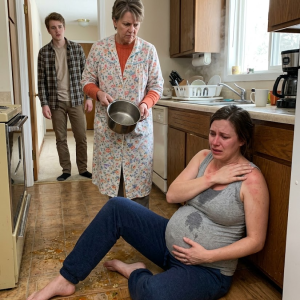
and precision of an emergency.
Janine filed for an emergency protective order and petitioned the court to freeze the remaining trust assets pending review.
Monica gave a statement.
Sandra sent her written assessment.
I forwarded every photograph and document we had copied.
Emily recorded a detailed timeline on video, naming medications, dates, canceled appointments, fundraisers, and the way the family coached her speech in front of others.
We also did something more ordinary and, in its own way, more radical.
We let Emily be seen.
Monica took her to a salon to trim the stringy hair Derek’s mother always kept tied back.
I took her shopping for jeans, sneakers, and two plain T-shirts that she picked out with the seriousness of someone choosing a new passport.
Sandra recommended exercises, and Emily started doing them in Monica’s guest room each morning.
Janine helped arrange an independent physician evaluation, which documented sedation history, no evidence of the catastrophic diagnosis the family had promoted, and signs consistent with prolonged inactivity and medication misuse.
At a diner on the third day, Emily ordered a cheeseburger and fries and then laughed halfway through the meal because nobody was pureeing anything for her.
“I forgot food could have texture,” she said.
I laughed too, and then I had to look away because I was suddenly close to tears.
The worst part of waking up inside a lie is recognizing the moments you helped hold it in place.
I had carried trays.
I had fetched blankets.
I had praised Derek for his patience.
He had never once hit me.
He had never screamed in my face.
He had simply narrated reality with such calm certainty that questioning him felt unkind.
Looking back, I could see smaller manipulations everywhere.
He read my texts over my shoulder and called it closeness.
He disliked my visiting old friends and called it wanting more couple time.
He always explained people to me before I knew them well enough to form my own view.
Emily had not just exposed what he did to her.
She had shown me the shape of the cage I was already starting to live in.
On the fifth day, Janine called with news.
The court had granted temporary emergency relief.
The trust was frozen pending investigation.
A detective from the financial crimes unit wanted to meet us when Derek and his parents returned.
Child protective services was involved because Emily was still a minor.
The police would not arrest anyone on a guess, but they had enough to be present for a formal confrontation and seizure of records and medication.
“Do not warn them,” Janine said.
“Let them walk into the story they created.”
So we did.
On the seventh day, Derek’s SUV rolled into the driveway just after noon.
I was standing in the living room beside Janine.
Monica sat near the window.
A detective in plain clothes waited by the dining room archway with a uniformed officer and a CPS caseworker.
Emily stood in the center of the room, upright, steady, wearing jeans and a navy sweater.
When the front door opened, Derek came in first carrying a souvenir bag.
He smiled before he fully looked up.
The smile died almost instantly.
Behind him, his mother gasped.
His father stopped so abruptly he nearly collided