and said nothing.
The quiet did something interesting.
People who had once treated me politely in public stopped returning calls when they assumed I had lost status with my husband.
A woman who used to beg for seats at our charity gala suddenly crossed the street to avoid me outside the grocery store.
One of Terrence’s cousins sent a text asking whether I planned to sell any jewelry to cover rent, dressed up as concern.
Grief stripped varnish off everyone.
It was ugly, but it was clarifying.
Ruth came every Sunday with food I did not ask for and stories I had never heard.
She told me Terrence kept my nursing school acceptance letter in his desk drawer because it reminded him that ambition could be honorable.
She scrubbed mud from my wedding album page by page at her kitchen table and pressed each sheet between towels so the photographs would not curl.
On the second Sunday she brought me a scarf, a pair of cuff links, and the fountain pen Terrence always used for handwritten notes.
Beverly had tossed them into a donate pile.
Ruth rescued them before they disappeared.
When I tried to press money into her hand, she closed my fingers back over the cash and told me kindness was not a billable service.
Samuel Ortiz, who had driven Terrence for years, showed up three days later with a cedar box and Terrence’s watch wrapped in a polishing cloth.
He said Terrence had asked him, if things turned ugly, to make sure those items reached me and nobody else.
Samuel would not step all the way into my apartment because he felt he was intruding on grief, but he stood in the doorway long enough to tell me that Terrence had talked about me in the car like I was the best decision he had ever made.
Then he left before I could say anything smart enough to deserve that kindness.
Andre came on a rainy Thursday night, soaked through and looking younger than I had ever seen him.
He held the cedar box Samuel had returned because there had been one more bundle hidden inside it, a stack of letters Terrence had written to himself during treatment.
Andre told me Beverly had ordered the guest room cleared after the funeral and he could not bear watching anything else of Terrence’s become trash.
He apologized for the lawn, for the silence, for a lifetime of letting louder people decide what kind of man he would be.
I did not forgive him on the spot.
Some wounds are too fresh for generosity.
But I saw something in him that day I had not seen on the porch: shame that wanted to become action.
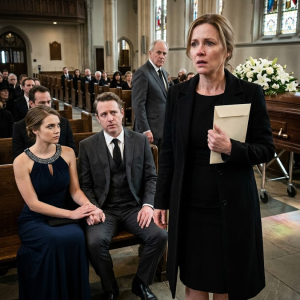
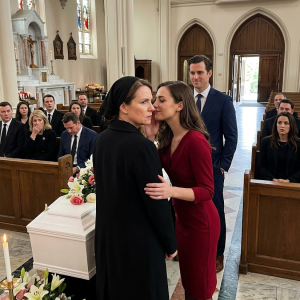
The memorial service arrived in a blur of lilies and expensive tailoring.
Beverly planned it like a coronation of her own suffering.
She seated me in the second row until the pastor, who had married Terrence and me, quietly asked that the widow be moved to the front.
Crystal’s mouth hardened so visibly I almost laughed.
When the pastor invited anyone who wished to speak, Beverly rose halfway from her chair, ready to intercept.
I stood before she could.
I did not talk about money or betrayal or family.
I talked about how Terrence remembered