had debt. More than I realized. Credit cards. A failed online boutique. A leased SUV she couldn’t afford. A European trip my parents had half-funded and she had the rest of the receipts to prove she should never have taken. The house wasn’t sentimental to her. It was an answer to a lifestyle problem.
To me, it was where Grandma taught me how to blind-bake a crust and Grandpa taught me how to patch cedar fencing. It was where I learned that being listened to could feel more nourishing than being praised. It was where I came when my own house felt too sharp to live in.
To Ashley, it was equity with ocean views.
The first direct confrontation happened six months after probate closed.
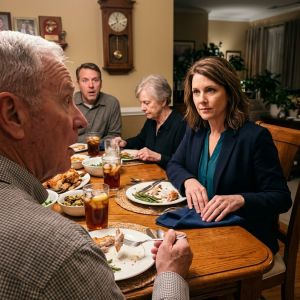
My parents arrived on a rainy Thursday evening and sat at Grandma’s dining table—my dining table by then—with the serious faces people use when they are about to rebrand greed as practicality.
Ashley came twenty minutes late, carrying takeout and false innocence.
My father cleared his throat. ‘We’ve been talking as a family,’ he began.
That phrase alone nearly ended me.
As a family.
Meaning: without me, but about me.
He went on. Ashley needed stability. Ashley had plans. Ashley wanted children one day. Ashley had always loved the coast. It would make more sense, really, for the house to be put in her name while I ‘focused on my career.’ My mother suggested I could always ‘visit.’
Visit.
My grandparents’ home. The home I had legally inherited. The home I had repaired, insured, cleaned out, and protected.
I looked at all three of them and saw, maybe for the first time without denial, that they truly believed I would fold.
Maybe because I always had before.
‘I’m not signing anything,’ I said.
Ashley blinked. ‘Why are you making this difficult?’
‘Because it’s my house.’
My mother’s lips tightened. ‘You’ve always had such a selfish streak.’
I laughed then. Quietly. Not because it was funny, but because some accusations collapse under their own absurdity.
They left angry.
I thought that would be the end of it.
It wasn’t.
A week later they returned with a smile too rehearsed to be innocent.
Ashley stepped into the foyer and said, ‘Good news. We had the house signed into my name. You’re out by Friday.’
I remember the exact angle of the afternoon light on the floorboards. The smell of lemons from the oil I had used on the dining table that morning. The way my mother stood just behind Ashley with satisfaction tucked into the corners of her mouth.
My father crossed his arms as if preparing for a tantrum he expected to win.
Instead, I smiled.
‘You really think I’d let that happen?’ I asked.
Ashley’s confidence wavered for just a second.
My father shoved a photocopy toward me. Some kind of quitclaim deed. A signature that looked almost like mine if you didn’t know how I formed my E’s. A notary seal that would have impressed someone unfamiliar with fraud.
I took one glance, then set it down.
‘You should leave,’ I said.
My mother’s eyes narrowed. ‘Excuse me?’
‘I said leave.’
They took my calm for ignorance.
That was their final mistake.
The recorder’s office called Samuel the next morning. The title freeze went