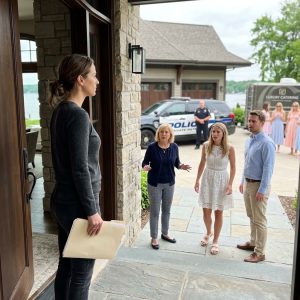
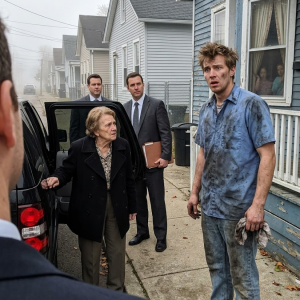
He stepped toward the doorway, hand out, voice sharp and ugly. “You vindictive—”
The officer moved instantly between us. “Sir. Stop.”
That changed the whole porch.
Not because Ryan was dangerous in a cinematic way.
Because nothing punctures masculine entitlement faster than another man, in public, telling it where the line is.
Frank grabbed Ryan’s elbow. Linda hissed his name. Heather backed down the steps. The whole family shifted at once from invading force to exposed problem.
Valerie, who had spent enough years dealing with rich men to recognize the exact second panic becomes negotiable, spoke into the silence.
“Emily is prepared to proceed both civilly and, if advised by the bank’s fraud unit, criminally. Whether that escalates will depend in part on immediate cooperation.”
Ryan stared at her. “Criminally?”
“Yes,” she said. “Some banks dislike unauthorized internal transfers from separate-property accounts once intent becomes clear.”
He looked sick then.
Not guilty.
Scared.
Good.
Because fear was the only language he had not forced me to speak first.
The porch standoff ended not with drama but with logistics. They loaded the suitcases back into the SUV. Frank said very little after that. Men like him get quieter as reality gets more documented. Linda tried one last little speech about broken families and disrespect, but it landed weakly in the open air. Heather cried in the passenger seat, not for me, not even really for Ryan, but for the humiliating fact that she had packed for a rescue and arrived at evidence.
Ryan was the last one to get into the car.
Before he did, he looked at me and said, “You’re enjoying this.”
That was almost sad.
Because even then, he needed to believe my clarity was cruelty.
“No,” I said. “I’m surviving it.”
Then I closed the door.
The legal process moved faster than he expected.
That surprised him because men like Ryan assume delay is a form of mercy built into the world for their convenience. He assumed I would cool off. He assumed embarrassment would soften me before paperwork hardened.
Instead, the bank’s internal review found more than we had first seen.
The fifty-seven thousand dollars was only the obvious trail.
Once forensic accounting got involved, the number rose.
He had used my account access not just for his parents and sister, but for hotel deposits, attorney consultations on behalf of Heather’s divorce, travel costs, and a private debt payoff for Linda I had never known existed. Each transfer had been disguised just carefully enough to hide in routine until the whole pattern was viewed together.
The final total sat just over ninety-three thousand dollars.
The bank froze his remaining linked authorizations permanently and referred the matter for possible fraud prosecution. Valerie used that leverage exactly the way leverage should be used: not theatrically, but efficiently.
Ryan’s lawyer called within three days.
The first call framed everything as marital confusion.
The second used words like misunderstanding and shared intentions.
By the third, after the bank had sent its own notices, the tone changed.
Settlement.
Restitution.
Non-disparagement.
He wanted quiet.
I wanted finality.
We got both.
Ryan signed a civil settlement admitting the funds were taken without my informed authorization, agreeing to full repayment on a structured but accelerated schedule secured by assets his parents once bragged about. Frank had to liquidate an investment account to cover the first half. Linda, I later learned, sold jewelry she had described for years as “untouchable.” Heather was left to solve her own life, which was perhaps the first useful thing Ryan ever did for her, even if by accident.