Separate property remained separate.
Restitution obligations remained in force.
No alimony.
No share of the house.
No romantic reward for audacity.
Ryan looked at me outside the courtroom afterward and said, “You could have just talked to me.”
That sentence nearly made me laugh.
Talked.
As though there had ever been a conversation to be had with a man who announced his family’s occupation of my home like a catering decision.
“No,” I said. “You could have.”
That was the last private thing I ever said to him.
A year after the day he brought his parents and sister to my porch, I hosted a dinner in the same house.
Not a huge one.
Eight people.
My attorney Valerie.
My accountant.
Two women I had known since before my company sale.
My brother from Seattle, who arrived with wine and the deeply satisfying sentence, “I always hated him, by the way.”
We ate in the dining room Ryan’s mother once expected to criticize into obedience.
The windows were open.
The pool lights glowed blue outside.
The house sounded like mine.
At one point Valerie raised her glass and said, “To Emily, who answered nonsense with documentation.”
Everyone laughed.
I did too.
Because by then, it was funny.
Not the theft.
Not the marriage.
But the original assumption behind all of it: that I would be too stunned, too ashamed, or too eager to preserve the idea of family to defend myself properly.
He told me the house was his.
He told me I bought it with his money.
He told me he would throw me out himself.
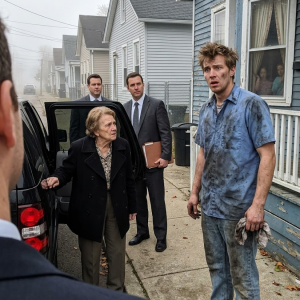
Then he arrived with witnesses and luggage and found an empty shell, a taped envelope, an attorney, and a police officer waiting on the porch.
That was the day he learned the difference between having access to a woman’s life and owning any part of it.
And that was the day I did too.