fast through my body that I thought I might strike her right there beside my daughter’s casket.
I did not move.
I fixed my gaze on Lucía’s coffin and forced myself to breathe.
It was not restraint born from dignity.
It was the kind born from knowing that if I let myself begin, I would not know how to stop.
There had been signs for years.
Lucía would come to my house wearing long sleeves in July.
I would ask whether she was cold, and she would nod too quickly.
She would step into my bathroom and stay there longer than necessary, and when she came out, her face would be freshly washed but her eyes would still have that red shine women get after crying in private.
“Álvaro’s under pressure,” she would say.
“Work has been terrible.
He didn’t mean it the way it sounded.
He’s trying, Mom.”
Sometimes she said he was tired.
Sometimes she said he was stressed.
Sometimes she said marriage was complicated.
There are endless ways to rename suffering when the truth feels too dangerous to say out loud.
I asked her more than once to leave him.
I told her my home was hers.
I told her she did not need permission to be safe.
I told her that love should not make her smaller.
But every time, Lucía touched her belly and looked at me with that unbearable mix of fear and hope.
“When the baby comes, he’ll change,” she said.
“He’s scared.
That’s all.”
Hope can be a beautiful thing.
In the wrong hands, it can also be a weapon.
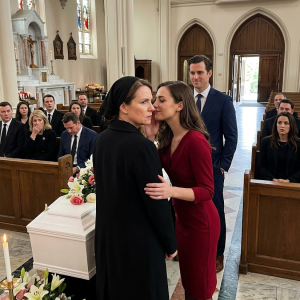
At the funeral, Álvaro took a seat in the front row as if none of us had a right to question him.
He crossed one ankle over his knee.
The woman in red sat beside him.
When the priest spoke the phrase eternal love, I heard Álvaro let out a low chuckle.
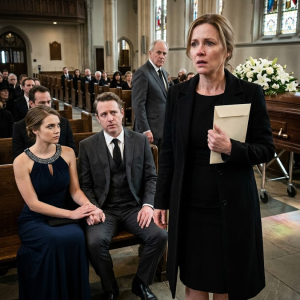
Then Javier Morales stood.
He had been sitting quietly near the side aisle, his gray suit immaculate, a sealed envelope resting on his lap.
I knew Javier only in the formal way mothers know the professionals their children trust.
He had handled Lucía’s paperwork after my husband died and later helped her with a property transfer tied to her inheritance.
He was not a dramatic man.
He was precise.
Careful.
The kind of person who chose each word before releasing it.
He walked to the altar with a steadiness that instantly changed the temperature of the room.
“Before the burial,” he said, projecting just enough to fill the church, “I have a legal instruction from Lucía Gómez, signed, notarized, and deposited with my office six weeks ago.
She directed that her will be read aloud before interment.”
A murmur moved through the pews.
Álvaro leaned back with an expression of bored arrogance.
“A will?” he said.
“My wife didn’t own a single thing I didn’t already know about.”
Javier opened the envelope and removed several pages.
“I will begin with the first beneficiary,” he said.
Then he spoke my name.
“María Gómez, mother of the deceased, is hereby named sole executor of this estate and temporary guardian of all assets assigned to the Lucía Gómez Trust.”
I stared at him, unable to understand what I had heard.
Temporary guardian? Trust?