of them, sent two nights before the crash, Álvaro wrote, Almost done.
After this, everything changes.
In another, after Lucía was already in surgery, he sent, Don’t call me yet.
Let me handle the family first.
I read those messages in a prosecutor’s office while Mateo slept in a carrier beside my chair, and something in me hardened permanently.
The trial began nine months later.
By then Mateo was healthy enough to come home with me.
He had Lucía’s eyes.
The first time he smiled in his sleep, I had to sit down because the resemblance hit me like a blow.
He became my reason to get dressed on days when grief felt too heavy to lift.
Courtrooms are strange places to carry sorrow.
There is nowhere to put it.
You sit upright.
You answer questions.
You speak in complete sentences while your entire body wants to howl.
I testified about the long sleeves, the excuses, the nights Lucía came over and barely touched her food.
I testified about begging her to leave and about the way she kept glancing at the door whenever Álvaro texted.
Javier testified about the will, the separation filing, the trust, and the sealed annex.
Detective Robles testified about the forensic evidence from the vehicle and the timing of Álvaro’s insurance inquiries.
Valeria took the stand last.
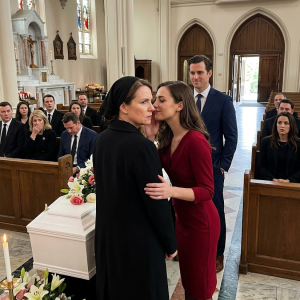
She looked nothing like the woman in the red dress from the funeral.
There was no swagger left in her.
She admitted accepting money and gifts.
She admitted knowing he was married.
She admitted enjoying the idea that she might soon replace Lucía.
Then she said the one thing I believe finally broke the jury’s patience with every attempt by the defense to paint Álvaro as merely selfish instead of deadly.
“When I asked him why he wasn’t crying after the crash,” she said, staring at her hands, “he told me not to be childish.
He said grief was for people who lost something.”
The courtroom went so quiet that even the judge stopped moving.
Álvaro was convicted on charges of murder, fraud, coercive abuse, and financial exploitation.
The sentence was thirty-four years.
When the judge read it, Álvaro did not look at me.
He looked at the floor, as though refusing my eyes might still preserve some final scrap of control.
It did not.
By then, the control was gone.
The lies were gone.
The version of him that charmed waiters, priests, and distant relatives was gone too.
Valeria received a reduced sentence on the financial charges because of her cooperation and was ordered to repay what she could.
I did not waste much emotion on her after that.
Women like her do enough damage without realizing that one day they may also become collateral in a man’s greed.
The trust Javier helped Lucía create did exactly what she intended.
Mateo’s future was protected.
The house on Rivera Street remained in his name.
The insurance money went into a monitored account.
And after the criminal case ended, I used a portion of the recovered assets to fund a small legal aid program through our parish for women trying to leave abusive relationships.
I named it Casa Lucía.
That was not revenge.
Revenge burns hot and then empties out.
This was something steadier.
Something useful.
On Mateo’s first