Three weeks after my divorce, I walked into a jewelry store to sell the last valuable thing I owned.
By the time I walked out, I no longer knew my real name.
Until then, my life had been small in the practical, humiliating ways that make suffering feel ordinary. Rent due. Phone cracked. Lip split often enough that concealer had become part of my morning routine. Double shifts at a diner outside Colorado Springs. A landlord who had stopped pretending patience was kindness and taped a red-lettered notice to my door like a public warning.
PAY BY FRIDAY OR VACATE.
That Friday felt like the edge of a cliff.
I had already sold what could be sold without raising questions. A secondhand microwave. Two pairs of boots. The television Derek had once called “ours” until he noticed I wanted to keep it. I had one room, one mattress on the floor, two trash bags of clothes, and a shoebox of my mother’s things tucked under the bed like a private grave.
Inside that box was the necklace.
Gold chain. Heavy pendant. Beautiful in a way that never fit the life my mother and I lived. She wore it on Sundays, Christmas, job interviews, doctor appointments, funerals—any time she needed to feel assembled. When cancer hollowed her out and words started leaving her before breath did, she pressed the pendant into my hand and whispered, “If you ever have no one left, this will find its way home.”
I had thought she was trying to comfort me.
I had thought dying women were allowed to be poetic.
So on the morning I took it to Whitman Jewelers, I was not expecting revelation. I was expecting maybe eight hundred dollars if I was lucky and half that if I wasn’t.
Instead Ellis, the man behind the counter, took one look at the clasp, turned pale, opened the pendant to reveal the tiny portrait and the name Isabella Vale, and told me the family that commissioned it had been searching for their missing heir for twenty years.
Then the back door opened.
An old man with silver hair and a cane entered like a storm in expensive wool.
“My name is Benedict Vale,” he said. “And if Marjorie Hale was the woman who raised you, then she stole you from my family the night my daughter died.”
Then came the woman in the camel coat.
Then Derek.
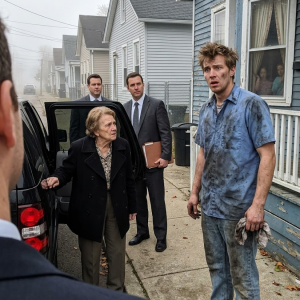
My ex-husband stepped out of a black car outside the open back door holding a manila envelope like he belonged there.
That was the moment the shock sharpened into fear.
Not confusion anymore.
Not disbelief.
Fear.
Because if Derek was involved, then whatever this was had already reached past coincidence and into strategy.
The woman in the camel coat noticed him too. Her face did not change, but her gaze flicked once over my shoulder and hardened.
“Why is he here?” she asked.
Benedict Vale did not turn around. “Because he contacted us first.”
I stared at him. “What?”
Derek came in without waiting to be invited. His tie was loosened, his hair still neat, his smile that practiced combination of injury and concern. He had used that face in court. Used it with neighbors. Used it whenever he wanted to look like the adult in a story where I had been assigned the role of problem.