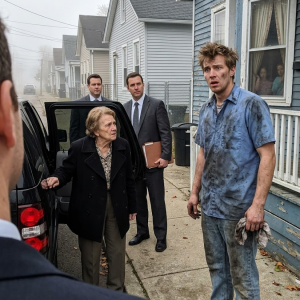
Derek spread his hands. “I wasn’t trying to hurt you. I thought if I brought the information to the right people, we could negotiate—”
“We?” I said.
He looked ashamed enough to be convincing if I had not spent years learning how little that meant.
“I was entitled to something for finding you,” he said quietly. “And after everything in the divorce—”
I moved before I thought.
The slap cracked across the office so loudly Ellis actually started.
Derek put a hand to his cheek and stared at me.
I had never hit him before.
He had clearly counted on that.
“After everything in the divorce,” I said, my voice shaking, “you thought the next fair thing was to sell me to strangers?”
“No,” Benedict said.
All of us turned.
His voice was quiet, but it cut through the room more cleanly than shouting would have.
“He thought he could sell access.”
Nobody answered.
Benedict looked at me with eyes that had clearly spent twenty years rehearsing impossible moments. “I am not asking you to trust me today. But I am asking you not to leave with him.”
I sat down again because standing had become impossible.
“Tell me about my mother,” I said.
Not Marjorie.
Not yet.
My mother.
Benedict understood.
He drew a long breath. “Marjorie Hale worked at Ash Vale then. Officially as a housemaid. In practice, she helped Catherine with everything. She was loyal. Smart. Invisible in the way good staff are often forced to be.”
Vivienne added, “And she saw more than the family men realized.”
“What did she see?”
“The argument,” Vivienne said. “The night before the fire. Catherine telling Adrian she had copied the financial records. Adrian saying if she took Isabella, she would regret it. Marjorie heard enough to know danger was coming.”
Benedict’s knuckles tightened on the cane. “When the fire started, Marjorie went into the nursery.”
I felt my breath catch.
Vivienne spoke carefully now, as if even after all these years the facts still cut. “We believe Catherine was already trapped in the east corridor. Marjorie could not reach her. But she could reach the child.”
“Me.”
“Yes.”
The office went silent.
I had spent nineteen years grieving a mother who died of cancer in a rented apartment that always smelled faintly of bleach and soup. Now I was being handed another mother—dead in a fire, rich, betrayed, elegant, and impossible.
Some part of me rebelled.
Some part clung harder to Marjorie.
“What happened next?” I asked.
Benedict looked at Ellis, then at Vivienne, as if deciding how much truth should arrive at once.
Vivienne answered. “Marjorie ran with you. At first, we thought the child had died. Later—months later—there were rumors. A sighting in Pueblo. A woman traveling with a little girl who matched your age. But by then Adrian had shaped the story. He said desperate staff were stealing valuables during the aftermath, inventing nonsense. He buried every lead.”
“Why didn’t you find me?”
Benedict’s face changed in a way that made age look painful rather than dignified. “Because I failed.”
He did not protect himself from the sentence. He let it sit there.
“I was broken by Catherine’s death,” he said. “And while I grieved, Adrian used attorneys, investigators, and influence to shut doors before I knew they were open. By the time I suspected Isabella had survived, Marjorie had vanished into a dozen small towns and cash jobs. She changed your records, changed her own trail, and never stayed long.”