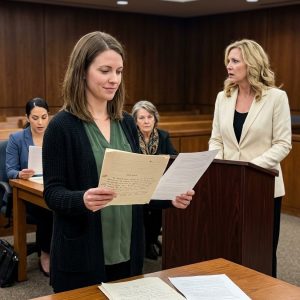
The legal process after that was long, technical, and emotionally exhausting. The court did not erase my motherhood because biology had finally reentered the room. Nor did it pretend the original adoption was morally clean just because it had once been legally stamped.
Instead, under family-court review, Tessa’s rights were formally acknowledged as having been wrongfully impaired, Lily’s records were corrected, and a new custodial arrangement was built around what best served a twelve-year-old girl rather than the egos of broken adults.
Lily stayed with me.
That part mattered.
She also gained what had been stolen from her: access to the truth, to Tessa, to her own original name and history without being forced to surrender the life she had actually lived.
She chose to remain Lily.
That surprised no one who knew her well.
But she asked for Grace to be added back as a second middle name.
So she became, legally and fully, Lily Grace Margaret Morrow Keller.
A child large enough to hold all the names adults had once used as weapons.
As for the trust, the trustees froze all distributions during the criminal investigation, then restructured it under court supervision so no adult guardian could quietly leverage it again. Education, housing, health, staged access later. Boring protections. Necessary protections. The kind built after damage, which is how too many safeguards are born.
Ben went to trial nine months later.
The prosecution did not need to prove every rotten thing he had ever intended. They only needed to prove enough of what he had done.
Fraud conspiracy.
Evidence tampering.
Financial exploitation targeting a minor beneficiary.
And, finally, murder.
The brake-line evidence, phone records, old intermediary ties, and his own messages sank him. Not dramatically. Methodically. Which felt right. Men like Ben count on chaos. They should be destroyed by paperwork.
He was convicted on all major counts.
When the verdict was read, I did not feel triumph.
Only release.
A pressure valve opening after too many years of invisible gas.
Owen was reburied the following spring.
Not because his first burial had been improper.
Because everything about that week had been contaminated by lies, haste, and the false version of him everyone was still using then.
This time Lily and I went alone at first.
Then Tessa joined us.
No pastor speech full of borrowed certainty. No casseroles. No selective nostalgia.
Just a headstone, damp grass, a quiet sky, and three people standing inside the truth at different distances.
Lily put down a small white flower and said, “He loved me badly, but he did love me some.”
It was one of the wisest sentences I had ever heard.
Tessa cried.
I did too.
Because complicated love still leaves wreckage.
And because naming a thing accurately is sometimes the closest we get to peace.
I sold the engagement ring two months after the trial.
Used the money to pay for Lily’s summer art program and a weekend trip to Lake Erie for the three of us. Me, Lily, Tessa. It rained half the time. The motel coffee was terrible. Lily bought a ridiculous sweatshirt with a gull on it and made us take the same boardwalk photo four times because “none of you know how to smile normally.”
It is one of my favorite pictures ever taken.