“You need to stop using this pregnancy as an excuse,” she said coldly. “Women have had babies for centuries without making themselves the center of every holiday.”
I turned slowly toward her. “I haven’t made myself the center of anything.”
She crossed her arms. “My son is up for partnership. Do you understand what that means? Important people are in this house. You will not embarrass him with your dramatics.”
There it was.
Not concern.
Not family.
Optics.
Everything in the Whitmore house was about optics.
I had known that before I married Thomas, but I made the mistake so many women make: I thought love would soften what pride had hardened.
Instead, love had simply given them closer access to me.
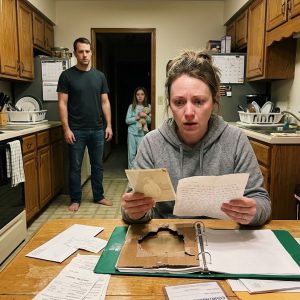
Another cramp hit, stronger this time, and I had to brace myself against the counter.
Margaret’s expression tightened. “Not tonight, Claire.”
“Please,” I said. “I think something’s wrong.”
She rolled her eyes. “You always choose the worst moment.”
Then she walked out of the kitchen.
I stood there alone, breathing through pain that no longer felt ordinary. My reflection in the dark kitchen window looked pale and frightened. I reached for my phone with shaking hands and saw three missed calls from my father.
My father.
The one person I had not told the truth about to this family.
To the Whitmores, he was just “my father in public service,” some old-fashioned man from a respected family who kept to himself. Thomas once called him “pleasant but politically irrelevant.” Margaret dismissed him as “ceremonial.”
I never corrected them.
Partly because my father hated status games.
Partly because I wanted to know whether they could treat me decently without a title standing behind me like a bodyguard.
Now I knew.
I called him back.
He answered on the first ring. “Claire?”
I hadn’t even spoken yet, and already my throat tightened.
“Dad,” I whispered.
That was all it took.
His voice changed instantly. “What happened?”
I looked toward the dining room where I could hear Margaret laughing with guests while I stood in pain in a kitchen I had worked in since dawn.
“I need help.”
“Are you alone?”
“Yes.”
A pause. Not from hesitation. From control.
“Are you in danger?”
The answer sat in my chest like a stone.
“Yes.”
He did not ask another question.
“Stay where you are,” he said. “Do not let anyone move you. I’m handling it.”
The line went dead.
I stood there shaking, trying to steady my breathing, when Thomas walked in, irritated.
“Mother says coffee should have gone out already.”
I stared at him.
He frowned. “What?”
“I called my father.”
Something in my face must have unsettled him because his expression flickered. “Why?”
“Because I asked my husband for help and he chose his mother.”
His jaw tightened. “Don’t start with that tone.”
Before I could answer, his phone rang.
He glanced at the screen and immediately straightened.
Then went pale.
“It’s the Judicial Ethics Office,” he said.
I said nothing.
He answered with a stiff little laugh, already trying to sound polished again. “Hello, this is Thomas Whitmore.”
I watched his face change while whoever was on the other end kept speaking.
First confusion.
Then disbelief.
Then outright fear.
Margaret swept into the kitchen at that exact moment, annoyed. “Thomas, what is taking so—”