stories about dogs with secret jobs.
There is a version of freedom that does not feel dramatic when it arrives.
It just feels quiet.
That was the version we got.
In late autumn, nearly a year after the party, Amanda showed up at my townhouse alone.
She looked older.
Smaller somehow.
Not because hardship had made her noble, but because it had stripped away the certainty that someone else would rescue her.
I almost didn’t open the door.
But Ryan was at a friend’s house and something in me wanted the conversation finished cleanly.
She stood on the porch and cried before I said a word.
Real crying, not the wounded performance I knew from childhood.
She said moving into a rental after losing the house had broken something open in her.
She said Gregory had left two months earlier.
She said she had replayed that Christmas night over and over and finally understood what I had been trying to say.
Then she told me the ugliest truth of all.
Gregory’s parents had been coming by, and Amanda didn’t want them asking why Ryan was there opening gifts when they hadn’t brought anything for him.
Instead of admitting her own selfishness or calling me to pick him up, she chose the easier cruelty.
She put a child outside to protect her image for thirty minutes.
I asked whether she had apologized to Ryan in her own mind or only to me in her emergency.
She said she had written him letters she never sent because she knew she hadn’t earned the right.
For the first time, I believed she understood the size of what she had done.
Understanding, however, is not the same as repair.
I told Amanda I could forgive her without restoring what existed before.
I said forgiveness was about refusing to let bitterness raise my son, not about reopening the door to harm.
I told her she would not have access to Ryan until he was old enough to decide whether he wanted that, and until I believed she could put his dignity ahead of her comfort.
She nodded like she had expected that answer all along.
Before she left, she said she was sorry for every year she let me play provider while she treated me as an obligation instead of a brother.
It was the sentence I had once imagined hearing.
By the time it finally arrived, I no longer needed it to move forward.
Still, I was glad it was said.
My father apologized properly a few weeks later.
Not with excuses.
Not with context.
Just a visit, lowered eyes, and the admission that he had failed his grandson because keeping peace with Amanda had been easier than doing the right thing.
My mother took longer.
She still struggled to say Amanda’s name and wrong in the same sentence.
But distance has a way of making some truths impossible to avoid.
Eventually even she stopped asking me to pretend nothing happened.
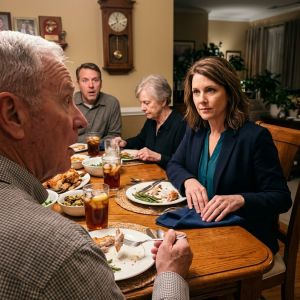
The following Christmas, Ryan and I hosted dinner in our townhouse.
It wasn’t fancy.
A roast chicken, mashed potatoes, store-bought pie, paper snowflakes taped to the windows.
Ryan invited a neighbor kid whose mother worked late.
I invited an older colleague from the office whose adult children lived out of state.
The living