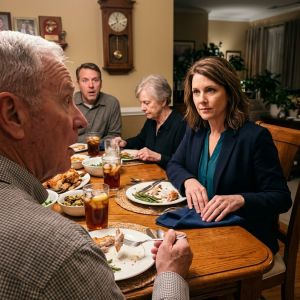
room was too small, the table was mismatched, and every chair was full.
At one point I noticed Ryan looking around with a smile that seemed to come from somewhere very deep inside him.
Later that night, after gifts and dessert and dishes stacked in the sink, he stood by the front door while snow fell softly beyond the porch light.
He looked up at me and said, almost casually, ‘Nobody waits outside here, right?’ I told him nobody ever would.
He nodded, satisfied, and went back to the living room where our guests were laughing over a board game.
That was the real ending.
Not Amanda losing the house.
Not Gregory disappearing.
Not the spreadsheet on the coffee table or the canceled payments or the silence that followed.
The real ending was smaller and better.
It was a child who had learned that exclusion was not his fault.
It was a father who finally understood that love without boundaries becomes permission for abuse.
It was a home where no one had to earn warmth by being useful.
I spent seven years funding the illusion that my sister’s family valued me.
It took one winter porch, one trembling voice, and one terrible sentence to make me face the truth.
They had mistaken my loyalty for weakness.
They had mistaken my consistency for endless supply.
They had mistaken my silence for agreement.
They were wrong.
I am still dependable.
I still show up.
I still help the people I love.
But now I know the difference between generosity and self-erasure.
And every December, when the lights go up and Ryan starts talking about cookies and music and wrapping gifts for other people, I remember the night everything broke.
Then I look around our home, at the room we built after the breaking, and I know with absolute certainty that losing that family version of me was the best thing that ever happened to us.