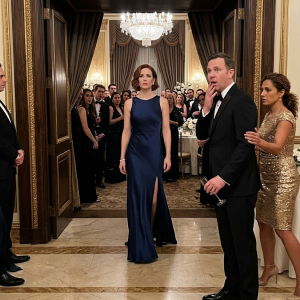
the witnesses, and the stains she had poured on herself.
When the officers asked her to come with them, she finally turned to me as though I had violated some sacred rule by refusing to remain beneath her.
I remember thinking that she still did not understand the real reason she had lost.
It was not because I had tricked her.
It was because my staff, once given a safe opening, had decided not to protect her lie anymore.
The next month was not glamorous.
There were interviews with attorneys, insurance meetings, and more document review than I hope to repeat in my lifetime.
We suspended Miguel immediately and terminated him after the investigation confirmed he had deleted incident reports, misclassified staff complaints, and accepted outside payments tied to Blaire’s shell company.
Civil claims followed.
The foundation’s board removed Blaire within days.
Donors demanded an audit.
A local paper picked up the story, then a national one, because Manhattan loves nothing more than a luxury scandal with surveillance footage and hypocrisy at its center.
Blaire’s fiancée, who had spent years enjoying her polished public image, ended their engagement before the month was out.
Westbourne unraveled once accountants began pulling at the threads.
I never saw her again except in photographs outside a courthouse, expression hidden behind sunglasses that fooled no one.
I did, however, finally learn who wrote the letters.
The first had come from Tanya.
The second from Nora.
The third, the angriest one, had been Malik’s.
They had not coordinated at first.
Each of them had reached the same conclusion separately: management would not protect them, and maybe the owner had become too far removed to notice.
When I asked why none of them had signed their names, Tanya laughed without humor.
She said because people with rent due cannot afford noble gestures if noble gestures get them fired.
She was right, and hearing it from her mattered more than any consultant’s report ever could.
I apologized to all of them, not in the polished language of leadership statements but plainly.
I told them that good intentions are not the same thing as safety, and generous policies mean very little when the culture teaches people not to use them.
Then I rebuilt the part of the restaurant I had neglected precisely because I had believed the shiny parts proved the rest was sound.
We created a zero-exception guest conduct policy and printed it on reservation confirmations.
We moved incident logging to a third-party system managers could not alter without an audit trail.
We added anonymous reporting that went directly to outside counsel and to me.
We trained every supervisor on intervention, documentation, and what it means to lose a customer instead of losing a worker.
Most importantly, we made it clear that revenue would never outrank dignity again.
Some regulars never came back after the story broke.
That turned out to be a gift.
The ones who returned came back differently.
They said thank you to runners.
They used names.
They tipped without performing generosity.
Staff shoulders loosened.
The floor sounded lighter.
Tanya became director of front-of-house training, which suited her perfectly because she could spot a power game at twenty paces.
Nora moved into guest relations and turned out to be exceptionally good at it once she