What followed was no longer the hearing Vanessa had imagined.
It became, instead, the beginning of an unraveling.
Because Judith had done one thing I had not known she was doing. After I showed her my father’s note in the hallway before the hearing, she had stepped away and made a call. Detective Daniel Ruiz of the Mayfield County Sheriff’s Office was already in the building by the time the judge ordered a recess.
He arrived in a dark suit, not a uniform, carrying a thin leather case and the sort of face that looked permanently unimpressed by family lies. He was in his fifties, tired around the eyes, and he recognized my mother’s name immediately.
“Patricia Carter,” he said. “Lake Norwood. Four years ago.”
My throat tightened. “You remember?”
“I remember thinking the accident report never sat right with me,” he said. “I also remember your father calling three months later asking for copies of everything we were legally allowed to release.”
That was the first moment I understood how much my father had done in silence.
The judge signed an emergency order authorizing the retrieval of safe-deposit box 411, and by early afternoon a bank manager had delivered the sealed contents to a private conference room in the courthouse. Present were the judge, the clerk, Judith, Vanessa and her attorney, Detective Ruiz, and me.
Vanessa no longer looked triumphant. She looked furious and brittle, the way glass does right before it shatters.
The box held exactly what my father had promised.
A thick transfer ledger, handwritten and tabbed.
Copies of bank statements.
Photocopies of signed authorizations with dates circled in red.
A jewelry appraisal for my mother’s sapphire bracelet, followed by a consignment receipt bearing Vanessa’s signature.
And two envelopes.
The first explained the money.
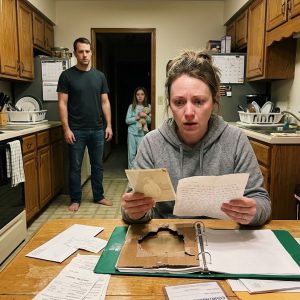
Over eleven months, Vanessa had siphoned $286,000 from my father’s assisted-living trust. She had done it in increments small enough to pass beneath attention at first, then in larger transfers once his tremors worsened and his handwriting became inconsistent. Some withdrawals had been disguised as care expenses. Others were routed through a consulting LLC Vanessa had opened six months earlier. My father had matched each transfer to something Vanessa bought or paid off: her condo arrears, a luxury SUV lease, credit-card balances, cosmetic procedures, two private tuition invoices for a man she had been dating’s children, and a failed “wellness” investment she had told the family was none of our concern.
Dad had annotated everything in the ledger.
March 14 — “Care reimbursement,” $8,500. No caregiver employed.
May 2 — transfer to VC Strategic Holdings. Same day: late mortgage cured.
July 19 — bracelet missing from Patricia’s cedar box.
September 3 — Vanessa says records are “being cleaned up.” That means hidden.
There was more.
My father had included a notarized letter from his estate attorney stating that the final version of the will had been executed during a documented lucid interval, with independent witnesses and video confirmation. He had known Vanessa would claim confusion or incapacity. He had prepared for that too.
By the time Detective Ruiz finished scanning the ledger, Vanessa had stopped making eye contact with anyone.
Then the second envelope was opened.
This one was thinner, but it carried the weight of a grave.
Inside was a letter from my father addressed to me.