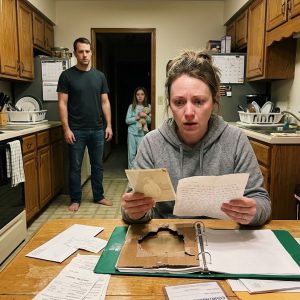
Elaine,
If you are reading this, then Vanessa finally believed grief would outrank truth.
I should have told you sooner what I learned. I did not because I was a coward first, and sick second. I kept hoping she would stop, confess, or leave us enough decency to bury one lie without uncovering another. I was wrong. So I am leaving you what I should have given while alive: the record.
Your mother did not die from simple misfortune at the lake. She died after confronting Vanessa about stolen money.
I had suspected Vanessa was moving funds long before Patricia proved it. The night Patricia drove out with her, she told me she was going to make Vanessa return what she had taken. Patricia left a voicemail at 8:11 p.m. because Vanessa was in the store and she was frightened enough to want a record. Ruiz has the copy. Your mother said, “If she tells you this is about my blood pressure, it isn’t. It’s about the transfers.”
Below the letter was a flash drive.
Detective Ruiz had brought a laptop.
The first file was the voicemail.
My mother’s voice came through small and unsteady, but unmistakable.
“Richard, I don’t want to alarm you. Vanessa says she wants to talk privately, and we’re at the marina by Lake Norwood. She’s angry that I found the bank folder. If I’m overreacting, I’ll apologize when I get home. But if she tells you I’m confused, I am not confused. I saw the transfers.”
I stopped breathing halfway through the message.
Vanessa stared at the table.
The second file was a security-video clip from the marina parking lot. Grainy. Black-and-white. Time-stamped. There was my mother’s car. There was Vanessa walking quickly from the dock alone. She opened the driver’s side door, reached inside, took something that looked like a folder and a handbag, then drove away.
The timestamp read 8:24 p.m.
The 911 call was not placed until 9:02.
The third file was an investigative summary from a private firm my father had hired a year after my mother’s death, when he realized official assumptions had closed too quickly. The investigator had recovered archived footage the original case never obtained, along with my mother’s deleted voicemail from a cloud backup Vanessa did not know existed. There was also a medical opinion attached from a cardiologist: based on witness timing and emergency-response logs, Patricia Carter likely suffered a severe cardiac event on the dock during emotional distress. Prompt emergency intervention would, in the doctor’s words, have made survival “more likely than not.”
My father’s final handwritten page explained the rest.
Vanessa had driven my mother to the lake after Patricia found the trust discrepancies and threatened to go to the police. They argued on the dock. My mother collapsed. Vanessa panicked—not because her mother was dying, but because the blue folder in Patricia’s purse contained copied transfers, account numbers, and notes. Rather than call 911, she took the folder and left. She later returned, called for help, and told responders my mother had insisted on sitting alone by the water after feeling “light-headed.”
It had been treated as a tragic delay.
My father had eventually proved it was a calculated one.
In the conference room, no one spoke for several seconds after the last document was read.