slowly tightening her expression.
Yes, Lourdes thought wildly.
Yes.
It is you.
‘Tala,’ she said.
The name seemed to disturb the air between them.
The young woman frowned.
‘Do I know you?’
Lourdes opened her mouth, but no words came.
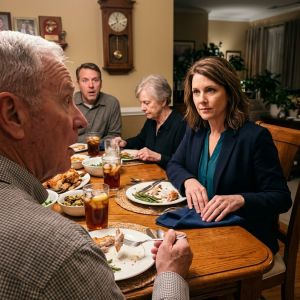
Behind Tala, a cough sounded from deeper inside the house, wet and tired and old.
Ramon.
Tala glanced over her shoulder.
‘Papa, someone’s here.’
Papa.
That single word nearly brought Lourdes to her knees.
Ramon appeared in the hallway moments later, thinner than she could have imagined, his shoulders caved inward by illness and by something that looked very much like guilt made visible.
His face had the yellow-gray cast of a body giving up.
For one strange second Lourdes saw all the years between them at once: the handsome young man she married, the stranger who vanished, the dying man before her.
It was like watching a whole lifetime burn down to ash in silence.
He stopped when he saw her.
‘I didn’t think you would come,’ he said.
Lourdes looked at him for a long time, and when she finally spoke, her voice was almost calm.
‘You made me bury both of you without a body.’
Tala stared at them, confusion turning rapidly into alarm.
‘What is this? Papa? Who is she?’
Ramon closed his eyes.
The effort of standing seemed to cost him.
‘Tala,’ he said, ‘sit down.
Please.’
She did not.
‘Who is she?’
Lourdes reached slowly into her bag and took out an old photo: a little girl on a beach towel between a smiling mother and father, all three still whole, still ignorant of what was coming.
She held it out.
Tala looked at the photo, then at Lourdes, then back at the photo.
‘I have more,’ Lourdes said softly.
‘Your first birthday.
Your baptism.
Your school picture from nursery.
The scar on your knee from falling off the tricycle.
The lullaby you used to demand three times before sleeping.
I know these things because I am your mother.’
The room changed then.
Not outwardly.
The chairs remained where they were.
The radio still played.
Rain still tapped faintly at the windows.
But something invisible cracked wide open.
Tala turned to Ramon with such disbelief on her face that Lourdes almost pitied her more than herself.
Almost.
Ramon sank into a chair as if his bones had collapsed.
What followed was not dramatic.
There was no shouting at first.
Only the slow, unbearable unveiling of truth.
He admitted everything.
He had been afraid of prison, of lenders, of public disgrace, of Lourdes finding out how much money he had lost and how completely he had betrayed their marriage.
Celine had offered him shelter and promises and a way to pretend he was still a man in control of his life.
He had taken Tala because he could not imagine beginning again alone, and because part of him knew Lourdes would fight for her if given the chance.
So he took away her chance.
At first he thought he would send word later, once he was stable, once the shame had faded, once he had built some version of a life that did not look pathetic.
But months became years.
Tala adapted.
Celine encouraged the lie.
Then Celine grew possessive and resentful whenever Tala asked